Jan 1, 2014 | Daily Life
A New Year generally brings about mixed feelings. Traditionally it’s a time to reflect over the year that’s passed, the good and the bad – and also to think about your aspirations for the year ahead. It’s also a chance to draw a line under the negative, and to have a fresh start. Over the last few years those goals for the year ahead have shifted quite dramatically for me. They used to be around completing my studies, and then became quite work focused – whether it was finding a job I loved, or making progress within my work. Taking the project I was working on forward, or becoming a manager. They may have also been more fun – like sharing memories with friends, going on holiday with family, or visiting new places. Over the Christmas period I managed to meet up with friends I hadn’t seen in awhile, and family members who told me their news, and it’s been playing on my mind ever since. They’re just getting on with their lives – getting engaged, celebrating promotions at work, looking forward to their holidays abroad, planning on meeting up for weekly squash. The kind of normality that’s just faded away for me. Thinking about the things that stick out for me from 2013 – they’re sadly mostly health focused, like being given the go-ahead for some new treatments, the nice consultants I saw, and the nasty ones. And then the biggest – having to stop working. When I look forward into 2014 I see a couple of dates – the lumbar injections in January, the infusions in March. ... read more
Dec 23, 2013 | Hospitals
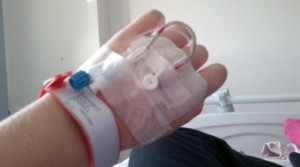
I stumbled across the treatment of ‘infusions’ sometime ago, and then kept seeing them being mentioned. I began to try to find out more about them, but information was limited. I was aware it usually consisted of either Ketamine or Lidocaine being given by an IV, and for some it works really well for pain relief. For others it seems to do nothing at all. Eventually a friend kindly offered to search the academic databases he had access to and sent me all the research he could find. They were generally all positive. ‘Intravenous Lidocaine: An Outdated or Underutilized Treatment for Pain?’ by Gary McCleane stated, “The drug is administered over a relatively short period of time and yet the potential relief lasts significantly beyond both the period of administration and the plasma half-life of this local anesthetic.” He goes on to state that, “an infusion over a few hours can produce relief that extends to weeks and even months. Consequently, side effects, if any are apparent, are short lived and last for a much shorter time than the pain relief.” McCleane explained that for many patients undertaking this treatment it becomes their only form of pain-relief, and they’re able to stop all other medications for pain. A trial of 82 patients found that 82% had a very good pain reduction after their infusion. In a second study on people with Fibromyalgia it was found that 40% of patients had between 13-18 weeks of relief. A second study called ‘Efficacy and adverse effects of intravenous lignocaine therapy in fibromyalgia syndrome’ concluded that the therapy “appears to be both safe... read more
Dec 16, 2013 | Coping Methods
Please note this post was originally published in the December issue of ‘Living Well with Fibromyalgia.’ When you’re in constant pain, it’s very easy to focus on it. It can become all-consuming, and the more you think about it – the worse it feels. Someone once suggested to me that I try crafting as a means of distraction. I have to be honest, I was a little annoyed – how would painting a pretty picture take my crippling pain away? It seemed a little dismissive. Plus there was also the fact I’d never thought of myself as a particularly creative or artistic person. At school even my doodled stick figures ran screaming in terror, and my art teacher made it clear it wasn’t my forte, but I thought I’d give card-making a try. I enjoyed making them, but they weren’t that great. I’d look online at all the beautiful designs people were creating, and it just didn’t feel quite like me. After I’d spent a fortune on card-making supplies, I decided to try my hand at jewellery instead, and in doing so found a new passion. The early days of making jewellery weren’t easy – my hands cramped up terribly, and I was left with blisters all over my skin. In time my dexterity improved and it helped strengthen some of my muscles in my hands. And it was true – when I’m busy concentrating on making a new item, my brain is focused elsewhere. It doesn’t make the pain go away, it just redirects my attention so I’m not thinking about it, which is really helpful. Once I... read more
Dec 14, 2013 | Benefits
This year my health has gone downhill somewhat. I suppose it has been doing that for some time, but when I finished my previous job I just knew I couldn’t do it anymore. I was a total mess, and my list of needs and adjustments from a job was getting longer than the job description itself. In April I applied for Employment and Support Allowance for the first time. For those of you that don’t know much about it, it’s the benefit that replaced Incapacity Benefit – for disabled people who can no longer work. There are three rates – the Assessment Rate, the Work Related Activity Group (WRAG) and the Support Group. If placed in the WRAG they admit you’re too ill to work currently, but feel you should be able to work with support in the future. People in this group have to attend regular work-related meetings with companies who receive bonuses if they can get you into work; can be forced into unlimited work-placements and can even sanction you. So in one breath they admit people in this group cannot work, and then force them too – and stop their benefits if they refuse. The Support Group means they feel you cannot work, and do not expect you to anytime soon. The way the system is supposed to work is that you receive the assessment rate for 13 weeks, then either a decision maker at the Department of Work and Pensions (DWP) decides if you should go in a group or be found ‘fit for work.’ If they feel they don’t have enough information they can... read more
Nov 6, 2013 | Benefits
A person with a disability has won a case against housing benefits officials when a judge ruled that a reduction of her housing benefit breached her human rights. It was agreed that she does require a separate room from her husband due to the her MS and the adaptations she required. This has positive implications for all of those with a disability impacted by the tax. Currently disabled people make up 63% of all those receiving a reduction in their housing benefit due to having a ‘spare bedroom’. In fact the bedroom is rarely spare – it’s often used to store medical equipment, been adapted for a specific purpose, used for those who can’t sleep in the same room as someone else due to their condition, or for someone who requires a carer – but not every night. The worst part of the new scheme penalising so many people is there isn’t a choice in the matter. One and two bedroom properties simply aren’t available, let alone houses that are suitably adapted. Often the person with a disability or the council have spent thousands of pounds on putting the right adaptations in place, sometimes even building an extension if the property wasn’t large enough to meet their needs. It’s then a cruel irony the room provided to make life easier for them ends up reducing their already inadequate benefits. The Papworth Trust have reported that disabled people being hit by the tax are being forced to cut back essentials such as food and other bills, and they state this “will also have a longer term impact on the NHS... read more
Oct 22, 2013 | General Posts
Living Well with Fibromyalgia is an online magazine written by and for people with the condition, and published by the fabulous website FibroModem. They are currently looking for people who would like to appear on the cover. It’s a great way to represent the normal people living with the condition, as well as get your chance to be a star! You need to submit your photo by the 1st November to contributions@fibromodem.com. Full terms and conditions can be found here. Good... read more
Oct 16, 2013 | Doctors
By 2010 I’d seen a string of consultants over the years, but none had been able to tell me what was wrong. They’d all been appointments of around 15 minutes, a quick look at my spinal movement, a couple of questions , a shrug of their shoulders and a dismissal. I left each appointment feeling lost and disappointed. A physiotherapist then mentioned I was very hypermobile, which then put me on a path of research into what that meant, the implications and I then came across the condition Ehlers-Danlos Syndrome which seemed to fit all my symptoms. I also found that one of the top specialists in the condition, Professor Rodney Grahame, was based at the University College Hospital London. I then had quite a fight to get the referral, having to go through the PCT and Rheumatology department at my local hospital – but finally I was informed they were willing to refer me for a second opinion and I had the funding for it. It took about six months until I saw Professor Grahame, in January 2011. I knew he was different when he began to put together a detailed overview from my birth to the current day. I was with him for over an hour – and he was very thorough and polite. He explained what was wrong with me, and some of the things I could try – including referrals to other specialists. I felt listened to, respected and finally had the answers I had been seeking for so long. He also followed my appointment up with a very detailed report that helped me secure... read more
Oct 11, 2013 | Coping Methods, Daily Life
I don’t tend to cry. I mean – give me a sad film, or book and I’m sobbing like nobody’s business. But in pain, randomly when it’s all just got too much? Not that often. (Although let’s take my last year of work out of the equation, because dear god I was a mess.) But I have cried in my last three appointments, and all three times it was around the same topics. Frustration at the “system” and exercise. The last few months have been tough for me. My condition seems to have gone into haywire, insomnia has struck big time, my pain levels are pretty damn ridonkulous and I’ve been pretty much stuck in the house. It’s always tough when you have a flare up, because of the fear this is your new reality. This is the next downward slide, on a slide that’s been pretty slippery for the last eleven years. At the same time there has to be hope. Sometimes I pin it on myself – I’m going to try this supplement, and do these new stretches eight times a day until every muscle in my body is strengthened and then… And then I’m doing the most basic of basic stretches, and put my joint out, and I’m lying on the floor with half my body shaking in spasm, trying not to throw up and thinking if I can just make it back to the sofa and not move for five days, it will be okay. So then I pin that hope on others. That I’m going to go to the physio and they’ll give me... read more
Oct 1, 2013 | Doctors
I’ve just started with a new Osteopath. I’ve been through so many therapists that I try and get a recommendation from someone I know first – which I did with this osteo. But on my first visit he announced he was off to Asia until March, so could only see me one more time. Today he assessed me further alongside the osteopath who I’ll be working with in the future. He pointed out my arch has fallen, and my left foot is falling inwards – which pulls my knees automatically into hyperextension. He suggested this would be putting a lot of pressure on my lower back. He also pointed out my mid -spine area is very hypermobile, but my lower back is locked solid – also putting additional pressure on. My hamstrings are very tight, as is my sciatic nerve. So there’s a few things to start with. Tomorrow I’m seeing a Pain Specialist at the Royal National Orthopaedic Hospital in Stanmore, Middlesex. The consultant isn’t an Ehlers-Danlos Syndrome specialist, but the EDS consultant at the hospital often refers to her, so she sees a lot of us. I’ve been putting together some information on Ketamine or Lidocaine infusions to discuss with her, along with research on EDS-related sleep issues and hope to also be referred for Lumbar Facet Joint injections. I get very nervous before I see a consultant, especially when I feel it’s a ‘last hope’ appointment. I’ve had some really bad experiences with the pain consultants at my local hospital, and I’m hoping seeing someone with an understanding of the complexities of EDS is going to... read more
Sep 24, 2013 | Access, Awareness
In April this year the law around ‘no win, no fee’ arrangements changed due to lobbying from the insurance industry around the so-called compensation culture. This has massively backfired onto the most vulnerable of society, and has made enforcing the Equality Act 2010 incredibly difficult. I wrote about this issue in August, but since then have heard almost nothing more about this problem. This is one of those subjects that should be making headlines, causing protests and marches, but instead the response has been limited. Just to summarise: If a person with a disability wanted to bring a legal case against someone – for example a bank, for refusing to provide a ramp, or a university for failing to adhere to a request to provide course materials in braille for a blind student, they could have entered into a no win, no fee agreement with a specialist law firm. These agreements are backed with an insurance policy, and would mean if the case was lost, the insurance company would protect them from any fees, and if they won – all the costs were met by the losing side. However, the change to the law has meant even if the case is won, they cannot claim the costs of the insurance premium back. It may be thought that it’s completely reasonable to pay the costs out of any compensation received – but damage payouts tend to be pretty low. In fact – most of the time it will mean having to pay out much more than any compensation amount they could ever hope to receive. This means the following: Legal... read more








 Hi, I'm Jade.
I'm in my early thirties, and live in the UK. I have multiple chronic illnesses with my main condition being Ehlers-Danlos Syndrome. This blog is about finding hope amongst the frustrations.
You can contact me at: info@chronicchronicles.co.uk
Hi, I'm Jade.
I'm in my early thirties, and live in the UK. I have multiple chronic illnesses with my main condition being Ehlers-Danlos Syndrome. This blog is about finding hope amongst the frustrations.
You can contact me at: info@chronicchronicles.co.uk

Follow Me