by The Chronic Chronicles | Oct 1, 2013 | Doctors
I’ve just started with a new Osteopath. I’ve been through so many therapists that I try and get a recommendation from someone I know first – which I did with this osteo. But on my first visit he announced he was off to Asia until March, so could only see me one more time.
Today he assessed me further alongside the osteopath who I’ll be working with in the future.
He pointed out my arch has fallen, and my left foot is falling inwards – which pulls my knees automatically into hyperextension. He suggested this would be putting a lot of pressure on my lower back. He also pointed out my mid -spine area is very hypermobile, but my lower back is locked solid – also putting additional pressure on. My hamstrings are very tight, as is my sciatic nerve. So there’s a few things to start with.
Tomorrow I’m seeing a Pain Specialist at the Royal National Orthopaedic Hospital in Stanmore, Middlesex. The consultant isn’t an Ehlers-Danlos Syndrome specialist, but the EDS consultant at the hospital often refers to her, so she sees a lot of us.
I’ve been putting together some information on Ketamine or Lidocaine infusions to discuss with her, along with research on EDS-related sleep issues and hope to also be referred for Lumbar Facet Joint injections.
I get very nervous before I see a consultant, especially when I feel it’s a ‘last hope’ appointment. I’ve had some really bad experiences with the pain consultants at my local hospital, and I’m hoping seeing someone with an understanding of the complexities of EDS is going to make a difference.
I’ve also booked in for my flu jab for a couple of weeks. I dread them, but the thought of it is usually worse! So just a reminder for all of you who has to have one yearly – winter is coming!

by The Chronic Chronicles | Sep 24, 2013 | Access, Awareness
In April this year the law around ‘no win, no fee’ arrangements changed due to lobbying from the insurance industry around the so-called compensation culture. This has massively backfired onto the most vulnerable of society, and has made enforcing the Equality Act 2010 incredibly difficult. I wrote about this issue in August, but since then have heard almost nothing more about this problem. This is one of those subjects that should be making headlines, causing protests and marches, but instead the response has been limited.
Just to summarise: If a person with a disability wanted to bring a legal case against someone – for example a bank, for refusing to provide a ramp, or a university for failing to adhere to a request to provide course materials in braille for a blind student, they could have entered into a no win, no fee agreement with a specialist law firm. These agreements are backed with an insurance policy, and would mean if the case was lost, the insurance company would protect them from any fees, and if they won – all the costs were met by the losing side. However, the change to the law has meant even if the case is won, they cannot claim the costs of the insurance premium back.
It may be thought that it’s completely reasonable to pay the costs out of any compensation received – but damage payouts tend to be pretty low. In fact – most of the time it will mean having to pay out much more than any compensation amount they could ever hope to receive.
This means the following:
- Legal proceedings will be reserved for only the richest in society.
- Shops and service providers will be able to ignore the law, as no one will be able to afford to bring a case against them.
- It has vastly reduced the power of the Equality Act overnight.
- Legal cases bring change that help shape society to be accessible to people with disabilities.
Today Unity Law has launched the Equal Justice Report, which you can read here. Please do read it to find out the specifics of what needs changing, and the impact it will have. Here are two simple ways you can help:
- Write to your MP. Unity has provided a template letter within the report, but I have found not all MPs respond well to a template letter – so write how it may impact you or your loved ones.
- Create a buzz on social media – share the report on every platform you can, and tweet using the hashtag #equaljustice
People need to realise the impact this will have, and that will only happen if we all pull together to fight back against this terrible change in the law.
Credit to Mconnors

by The Chronic Chronicles | Sep 23, 2013 | Access
How many times have you heard a story of a wheelchair user being refused access to a bus, and left waiting in the cold, snow or rain? It happens all the time.
I’ve heard reports of wheelchair users being left stranded for hours, being told they can’t get on the last bus of the night and even of one driver telling the other passengers that if they allowed an electric wheelchair onboard then it might blow up.
Despite these many cases, the bus companies often seem indifferent. I’ve had quite a bit of experience of this myself as chair of an Access Group – over the years I’ve had numerous complaints from members about local buses, and the letters back from the bus companies always follow the same formula. An apology, and a promise that drivers are trained in disability awareness. When we’re tried to follow up on this – and ask whether we could perhaps run a training session, or even just see the materials that they’re being trained on, but we’ve been met with radio silence.
I was very interested to see that Unity Law, a disability specialist firm based in Sheffield had taken on the case of Doug Paulley, a wheelchair user who was unable to get on a First Bus when one of their drivers wouldn’t make a parent with a pushchair move out of the space. Having contacted them in the past about similar issues and having not got anywhere, he decided to he contacted Unity to see what could be done legally.
The good news is that today a judge has set a legal precedent by agreeing that the policy must be prioritisation for wheelchair users, as the ‘first come, first serve’ policy contravened the Equality Act 2010. First have been given six months to retrain staff and put this in place, but the great news is the judgement will mean that all bus and train operators will have to adopt similar policies, or face similar legal action.
This is great news that will make travelling by public transportation a little bit easier for people with disabilities.
Bus in Ireland (Photo credit: Wikipedia)

by The Chronic Chronicles | Sep 15, 2013 | Daily Life
If you have a chronic illness, then you often have a lot of days in bed, or stranded on the sofa. I’ve been having a lot of those lately, and so I’ve been looking for new TV shows to watch. I’m not looking for shows that need any brainpower – just ones I can marathon and enjoy even if I fall asleep halfway through!
Here’s a rundown of some easy-watch TV I’ve been enjoying lately. For some reason, I think all these shows are on TLC. It’s channel 125 on Sky, and 167 on Virgin in the UK if you want to check them out.
Sister Wives
I’ve been watching this one for quite some time, and am excited it’s just starting in the UK. It follows a Mormon family that consists of a husband called Kody Brown, his three wives Meri, Janelle and Christine, and their 13 children. The show begins with Kody dating Robyn, and her then joining the Brown family as his fourth wife. The show is a fascinating look at polygamy and all the benefits and downsides. Every wife is completely different, and the show doesn’t shy away from showing the jealously between the wives and the long transition both the wives and the children go through to accept Robyn and her three children. I also enjoy the interviews with the older children – who have mixed views on polygamy themselves. This one is my favourite.
Watch this for: Family dynamics, a peek into a different world, lots of interesting background information slowly revealed and lots of highs and lows.
Dance Moms
I have a love-hate relationship with this show. It follows an ‘elite’ dancing team that go to competitions every week, although much of the focus is on their mothers and the drama both between each other, and them and the leader of the dance studio – Abby Lee Miller. Abby treats the children like crap – preferring to bully them, scream at them and insult them, than to just teach them. I find this very difficult to watch, and get frustrated with the mum’s who often declare “I’m done,” storm out, before they return the next day. I don’t know how much of the drama is for the cameras, because I cannot understand why any parent would allow their children to be treated that way. There are some pretty epic showdowns between the mums – even some physical fights thrown in.
A major running theme of the show is Abby’s blatant favouritism of Maddie, one of the girls in the group. While she is a great dancer, the other parents wonder if their child would be as good if Abby spent that same amount of time and energy with them, and were treated as nicely.
I particularly root for Chloe and Nia, and I worry for Brooke – who is an acrobatic contortionist, and with her extreme flexibility and long-running chronic pain – I worry is hypermobile and could be heading for a world of trouble.
Watch this for: Extreme drama, talent, parental relationships and fantastic dance routines.
Cheer Perfection
This show is still quite new, but follows a group of young cheerleaders in the US, and more importantly the drama between the mothers. The show differs from Dance Moms in that the coach Alisha actually treats the children well, and just wants some peace from the drama!
Watch this for: Drama, spoilt diva mothers, lots of sentences including y’all and backstabbing.
Breaking Amish
I caught this one as the first season is available On Demand through Virgin. It revolves around a group of young adults – four Amish, and one Mennonite, leaving their communities to move to New York. I had no idea what I was expecting, but within a few episodes there were arguments, relationships, modelling, tattoos and a whole lot more. There are rumblings this show isn’t entirely true, but it’s still pretty entertaining.
Watch this for: A look into another culture, tension between the group members and lots of past revelations.
LA Ink
I have only watched half a season of this so far, but I’m about to marathon it from the beginning because it’s got my attention. It follows a tattoo shop in LA (no surprise there!) ran by Kat Von D. So far it from what I’ve watched the shop is a tight-knit group, with the newest employees being outcast for varying reasons.
Watch this for: Tattoos ranging from pretty to horrible, the odd celebrity visit and lots of shop-based drama.
What fluffy shows do you like to watch when you’re not at your best? I foresee a lot sofa days coming up – so the more recommendations the better!
Credit to Alvimann

by The Chronic Chronicles | Aug 27, 2013 | Daily Life
In my next life I shall be a cat who sleeps anywhere.
I was settling down to go to sleep the other night, and putting my joints in the right positions – and it made me think about how much effort I have to go to at night to get it right. Most people jump into bed, lay in whatever their favourite comfortable position is and go to sleep. But for me, a lot of thought has to go into it, and it still often goes horribly wrong!
First of all it’s all about placement. I have to make sure no joints have too much pressure on them – particularly my hips, knees and shoulders. Sometimes it’s a no-win situation, for example I have to sleep on my side, and if I lay with my shoulder underneath me then the pain builds. However, if I pull my shoulder forward to take the pressure off – it’s likely to subluxate or go into spasm.
Many of my joints have to be bent – particularly my elbows and knees, otherwise they will lock in hyperextension (this is when the joint goes past its normal range of movement) and ‘freezes’ in place. When this happens I have to warm the joint up, and then slowly, and very painfully force it out of hyperextension and fold it back into position. It will usually throb with pain sometime after this.
However, other joints must not be bent, including wrists, and fingers, otherwise oddly they too will freeze in this position. Last night I ended up in a lot of pain because in my sleep the top joint of one of my fingers had bent. The pain in just that one tiny joint woke me up and kept me awake for some time!
Most importantly – with any joint, they cannot get left in the same position for too long, or I’ll be in for a world of pain in the morning. So I have to wake up regularly to turn over, and move each joint in turn. Often a joint gets locked up – usually one of my hips – and I have to turn over and try and drag it over with me which is more difficult than it sounds.
In addition, as anyone that knows me will have seen and heard – I’m always having to crack my neck. This continues throughout the night – with the pressure in the joint building up until it wakes me, and I have to crack it all out which you can’t do very well lying down.
Sometimes trying to solve one issue causes another. For example putting a cushion between my knees help eases my lower back pain slightly. However, on day three of using this cushion I get absolutely horrendous hip pain that leaves me unable to walk.
No matter how carefully I try and keep in the right positions, my fidgeting continues into my sleep and that causes a lot of problems. I cannot sleep on my back, at all – but sometimes this happens, and in return I wake up screaming with burning nerve pain shooting down my leg. I also frequently get cramps, or muscle spasms that make me jump awake.
This is just a normal night – often I have an injury, or a flare up in a specific joint that throws everything out.
So you wonder why I’m tired? People with Ehlers-Danlos Syndrome struggle to get into the final REM restorative stages of sleep. We also tend to wake up naturally hundreds of times a night. On top of that, I suffer from insomnia – and often don’t get to sleep at all until 6:00am – 7:00am.
So no, I don’t do mornings.
Fellow EDSers – do you relate?

by The Chronic Chronicles | Aug 21, 2013 | Access
Access for people with disabilities is something I’m passionate about. If there was another group of individuals in this country that were so utterly restricted from accessing shops, services, or simply going about their daily life – there would be an outcry. Yet access for disabled people is something that is still regarded with apathy, ignorance, and a lack of understanding.
A typical sight on the High Street – a step that would stop a wheelchair user gaining access, that could easily by solved with a portable ramp.
But I too was one of those many, many people that had no idea how poor access was in this country until I became disabled myself. The first time it really hit me how hard something I’d found so easy such a short time time ago, was a few years ago when my mobility got to the stage where I couldn’t walk around the town anymore. I signed up to Shopmobility and rented their smallest scooter in order to do some Christmas shopping.
The whole trip was a disaster. Being winter, most of the shops had closed doors. It’s almost impossible to reach from the scooter to open a door, hold it and drive through – and many of the doors were very heavy. It’s also difficult to get off the scooter at every doorway to open it, and then drive through while standing and trying to hold the door! If you’re regularly having to dismount from the scooter, it very much defeats the purpose of using one to reduce pain and fatigue.
So, I struggled to get into many shops – and this was while expecting to only be able to get into the larger chain stores. Many of these shops packed their aisles with displays, which made it hard to get round. It meant I had to regularly get off the scooter to move displays out the way in order to get through.
On top of this many shops had steps to get into them, or steps in the middle of the shop to another level that I hadn’t even thought twice about before. Tills were difficult to get to, with many having tight pathways to follow, made all the more difficult by the excess of shoppers.
I also found a lack of dropped kerbs around the town centre, with market stalls or delivery vans across many of those that were there, meaning I often had to go a great distance out of my way to take a route I needed to go, which meant between struggling to get round every shop, having to take longer routes to avoid steps or to find dropped kerbs, in addition to the struggle with doors – the whole trip took so much longer than it would normally have done.

An example of a “dropped-kerb” that made my wheelchair slam against it.
The final straw came in WH Smith. It was the final shop I needed to go to. I was pretty much shaking in pain and exhaustion before I even went in, but I immediately found myself stuck multiple times by narrow aisles and poor placement of displays – even worse than any other shop I’d been in, and then got completely trapped in a terrible queuing system. While trying to manoeuvre to free myself, some shopping fell off the scooter. In total exhaustion I got down on the floor to try and pick the items up, but shoppers continued stepping over me to join the queue – making me feel invisible and worthless. Staff watched me, but ignored the whole issue. Another shopper called out to a member of staff, asking them to help – but she simply stood watching. Finally back on the scooter, the only way I could see out was to drive into a display and knock it, which I did – knowing the comments of ‘terrible driver’ I was getting. Finally I reached the till to find it too high, and the PIN machine locked into position. It may be funny to look back on, but this was my first outing using a scooter as someone in their early twenties, gutted at having to be using one anyway – and left mortified by the whole experience (and in agony!). That embarrassment soon turned into anger. Why an earth hadn’t a large national shop like WH Smith achieved the most basic level of accessibility?
I was so upset I wanted to do something, so I found my town had a disability access group, and wrote to them asking for their help. Shortly afterwards I joined the group, and after a lot of nagging, complaining and meetings I was thrilled when WH Smith made a number of changes that made it much easier for people with disabilities to access their store. However, a year later they changed their shop layout again and changed their tills to a self-checkout system that people in wheelchairs couldn’t reach, undoing all our hard work. It quickly became clear to me that access was a big issue, and both achieving and maintaining it even harder.

This shop has a wide pavement outside, giving plenty of room for a ramp, but has chosen not to provide one.
In time I became the Chair of the access group but sadly we are extremely limited in what we can do to improve physical access. Getting change isn’t easy. Many shop owners simply ignore our requests, tell us it’s down to the council to provide ramps, or tell us they will make changes which then never appear. Most of the time I feel the group just bangs our head against a brick wall – but when a positive change is made it’s a great feeling.
However, the law recently changed to make it much harder to enforce the Equality Act. After lobbying from insurance companies, the way ‘no win, no fee’ cases are funded changed so that the claimant has to pay the insurance premiums upfront. These can cost thousands – and are usually more than any damages/compensation would ever be. This has made the ability to afford to bring a disability discrimination case about only possible to the very rich, whether the issue is something relatively simple like a local shop who won’t fit a ramp – to the worst possible cases of discrimination possible.

An excellent example of wheelchair access close by the main entrance.
I’ve barely heard this issue spoken about yet, yet I’m completely horrified by this change and the damage it will cause. It now means we’re relying on simply the goodwill of shop and service owners to make changes – which in many cases simply won’t happen.
This is yet another subtle change in the system that points overwhelming to a systemic campaign against people with disabilities that continues on. But sadly – apathy and ignorance are winning this war.
For more on access, try the post Disability access made easy!
[jetpack_subscription_form]

by The Chronic Chronicles | Aug 15, 2013 | Access
In Britain we have pretty good disability discrimination legislation. It’s quite extensive and covers physical access, employment and more. The Disability Discrimination Act came into force in 1995 – eighteen years ago. It’s been updated and strengthened multiple times since then – in 1996, 1999, 2004 before it finally ceased to exist and was instead included in much broader legislation called the Equality Act 2010. This included seven different protected characteristics which included disability, and states that if two people with protected characteristics have conflicting needs, then the disabled persons needs comes first.
However, I believe there are two particular flaws with this legislation – the first is getting companies, building owners and service providers to pay attention, fully comprehend and implement the law.
The second flaw is around enforcement. I will cover this issue in the post ‘Why we’re losing the war on Disability Access.’
Access Made Easy:
1) Access is generally about common sense. This includes putting a little thought behind decisions such as the layout of shop, and quite simply treating people with disabilities like you’d wish to be treated. For example – many shops have hearing loop systems, but don’t turn them on, fix them when they break, or train staff how to use the system. If you put a blue badge space outside your shop door – don’t use it for storage instead! If you’re installing a ramp to help wheelchair users and those with mobility problems, don’t put it at the back of the building. The closer it is, the better. The law states that it’s not enough just to have an adaptation – but to make sure that it’s usable.
2) Access doesn’t have to be expensive. The law asks for reasonable adjustments, and does make allowances for cost. It wouldn’t be expected that a small shop knock their entire shop down to replace it with a fully accessible one, or to install a permanent ramp. There are always ways to improve access though – such as a lightweight ramp that can be moved, a doorbell placed outside to allow people to call for help if needed, a portable hearing loop system, etc.
3) Never underestimate staff training. I have never had decent Equality and Diversity training, despite working for a range of councils, charities, universities and private businesses. It’s usually a patronising online module that tells you nothing about what it’s like to be disabled. There are lots of different kinds of disabilities out there and stereotypes attached to them. Some are harmful, some are just assumptions. Some I’ve heard just in the last week include:
• Wheelchair users cannot walk at all because their legs don’t work.
• AHDH is a fad, and is just naughty-child-syndrome.
• If someone is deaf just shout at them.
• If your child has Autism, then you should just be a parent and watch them at all times rather than expect their environment to be made safe.
• Only older people can have mobility problems.
Staff that have good training are going to lessen the chance of causing offensive, having complaints made about them – and more importantly increase the chances of meeting the needs of the customer and getting them to return again.
4) Accessible shops, or places with good customer service will get more custom. Disabled people have money to spend too. And to me – a shop that could easily make adjustments and hasn’t says to me “you are not welcome.” It’s mostly because the shops in the town centre I live in is so hard to get around I moved to mostly online shopping.
A cafe in the town centre that is inaccessible to wheelchair users
A few months ago I wanted to buy a gift for someone, and only had one day to buy it. My problem, however, was that my wheelchair was out of action. I checked online to make sure it was in stock, and headed to Homebase. The item I wanted was a plant – so I hoped if I could park outside the door, and go straight to the plant display nearest the door, I might just make it. However, I couldn’t see the plant – so I staggered over to customer service, already way past my walking limit. I explained to the lady I couldn’t stand long and couldn’t find what I wanted. She immediately brought a chair round to me without asking, then went to find the item, rang it up and called for someone to carry it out to my car for me. It seems simple, but it was so rare to be treated this way it actually brought tears to my eyes, which I know is pathetic! I wrote to thank Homebase and the lady in question and hope all their staff are like that. Next time I need to buy something gardening related – I’ll head to Homebase.
It’s important to note – most people will not complain about the step in the doorway, the packed displays, the till they can’t reach – they just won’t return.
5) New builds – get it right! While there is a certain level of understanding that it’s harder for older buildings, if you’re creating a new public building then please make an effort. The town I live in recently opened a massive shiny new art facility that cost £28 million. I was therefore incredibly disappointed they got some really basic things wrong. There was a whole list of issues – but a couple of the problems included a disabled toilet with an automatic light that turned off after a minute. So the person had to get off the toilet, and go outside into the corridor to turn it back on, or have fun in the total darkness. The second was the disabled parking was blocked off by locked bollards. In order to park, a wheelchair user had to pull up in the road, get their wheelchair out, head the 30m or so into the building, find a member of staff, wait for them to unlock it, go back to the car, put the wheelchair back, drive into the space, and get the wheelchair back out again. (For for many non-wheelchair users the distance was too far to reach the building from the road.) It’s very frustrating when such basic things are done so badly.
Finally: 6) It’s the law so just do it!
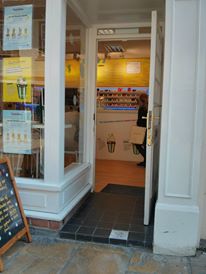
The staff in this shop ignored my attempts to gain access in my wheelchair. The manager later stated no one else had complained they couldn’t gain access. But how many people didn’t even try?
In terms of access, which simple changes would make your life easier?

by The Chronic Chronicles | Aug 1, 2013 | Daily Life
Blue Badge parking is a fantastic invention, and makes life so much easier for people, but there are often places where there simply aren’t enough spaces for everyone.
In my town – it’s at the local hospital. Parking has been an issue there for years, with the hospital regularly moving external departments to the same main site – but never increasing the parking. The worst place for this is at the wing that contains physiotherapy, the various gyms, hydrotherapy, prosthetics, etc. I always arrive early to my appointments – and it’s luck of the draw that you either catch someone leaving, or have a long wait. The way the car park is laid out there isn’t an easy way to queue up, so people dot about and just have to keep an eye on who is next in line.
So today I had hydrotherapy and arrived about 20 minutes early. I waited, and waited. After about 15 minutes, a lady crossed the car park heading to her car. I pulled out, signalling to make it clear I was waiting – when a new car arrived, and rushed in, passing me. I couldn’t have pulled out further as it would have blocked the lady from leaving. I head towards the space, as he starts to back in. I beep, and wave to get his attention. He ignores me, and parks.
When he gets out – I ask him why he did that. He shrugs, and said he didn’t see me. If someone doesn’t see a car in the middle of a carpark, signalling and beeping – they shouldn’t be driving.
So I wait, and wait – my appointment time passes. There’s nothing I can do, no where else to park. Eventually another lady moves her car, and once again a massive four-by-four suddenly drives in and takes the spot. I’m furious.
Again, I ask her why? I’d been waiting half an hour, missed my appointment time – and there is a queue. She says her daughter has an appointment. Right, well no one goes to the hospital for fun? I explain I do too, and I’ve been waiting like everyone else. She then looks at me and says “It’s your problem.”
I can’t repeat what I said next.
When did common decency vanish? Everyone knows parking is difficult at this hospital, and most of the time everyone does their best to keep the system fair. It sounds like such a minor thing, but in the end I had to park on a verge, then struggle desperately to get my wheelchair out and down the kerb. My stress levels were high by the time I got to my appointment, fifteen minutes late – which then increases my pain. It just makes me not want to go the hospital anymore, as the parking situation is so ridiculous!
Credit to ralaenin

by The Chronic Chronicles | Jul 26, 2013 | Doctors

A good GP is like gold dust.
It’s not that I believe the vast majority of doctors are bad doctors, it’s just that I think many have a specific attitude to healthcare. They want to see a patient, diagnose the problem, hand over a prescription and see them in a few years time for another issue.
However, when someone has a chronic illness – they’re obviously way past that point. There are no antibiotics for us, no treatment that will make it go away – and I think many doctors find that frustrating.
It takes a special kind of doctor to remain supportive and helpful in the long-term. To not give up as soon as one medication fails, or a treatment doesn’t work as suspected, or a medication helps one symptom – but creates another which now needs treating.
I have a check list of some of the qualities I like in a GP:
* A good doctor doesn’t roll their eyes when they ask how they can help, and you pull out a list. A good doctor realises for a chronically ill patient each symptom is connected, and shouldn’t be restricted into only discussing one problem at a time.
* A good doctor realises every symptom has significance. For example, the medication I am on for pain relief has unfortunately caused me to have acne. I find this really difficult, and I don’t want it dismissed as there are more ‘important’ issues.
* A good doctor doesn’t get frustrated when you come in clutching the latest breakthrough study, but reads it and explains whether it’s possible in my case or not.
* A good doctor let’s you cry when it’s all too much, and is thrilled for you when something goes well.
* A good doctor doesn’t dismiss a new symptom as just part of the condition, and carefully checks it first.
My GP is amazing. She has this special quality about her that you feel she truly cares about all her patients. She fights for us – will battle the system or a consultant when needed.
A GP to me is more important than a good consultant. They are really in charge of your care, your medication and the day-to-day stuff of your condition.
Unfortunately, a few months ago my GP informed me she was leaving the practice. I was, and still am, gutted.
I’ve been with the GP practice my whole life – but since I moved to the other side of town, and since the one GP at the surgery I like will be going, it made sense to move to one closer to home.
My GP highly recommended a specific doctor as best to treat my particular condition, but when I called them the receptionist informed me I was out of their catchment area by a road. When I told her though, she immediately picked up the phone and said not to worry, they owe her a favour and she’d cash in it. By the time I got home I’d had a call from their practice manager to say I was welcome to join the surgery.
Today I have my last ever appointment with her. I’ve got her a thank you gift, but I know there will be more tears!
Edit: There were tears from both us.

by The Chronic Chronicles | Jul 26, 2013 | Opinion
I am currently going through the awful process of claiming Employment and Support Allowance. This is the ‘unable-to-work’ disability benefit that replaced Incapacity Benefit in the last couple of years.
To put it mildly – it’s a stressful process. When you have a disability, you try to focus on the things you can do. You think about alternatives, or ways in which you can take part. However, ESA turns all that on its head – and you have to detail all the things you can’t do. It’s a depressing process. It’s also a long one.
To claim the benefit you begin by being signed off sick by your GP, once your work has ended. You get put onto an assessment rate. After approx 13 weeks you’re sent a form called the ESA50. It’s a lengthy form, very repetitive – where you have to justify such criteria as why you would struggle to pick up an empty cardboard box repeatedly, safely and reliably.
You’re expected to put medical evidence together with this form. When the system was set up – the Department of Work and Pensions or ATOS were supposed to request medical evidence on your behalf, but they did so on very few cases. Therefore claimants were being turned down for a lack of medical evidence! The claimant would then have to gather the medical evidence they thought had already been asked for in order to appeal and win the case – causing unnecessary stress, and time and tax payers money to be wasted.
So many claimants began to ask their doctors for evidence upfront. I’ve had two experiences with this – the first time my GP said not to worry, she would be asked automatically as part of the process. Of course no form was sent. Since then, many GPs have realised the system is failing, and some have changed their attitudes having seen the aftermath for their patients.
A couple of weeks ago I went to see my GP again, and she was very sympathetic. She immediately said of course she would, and she’d make it as detailed as possible. A few days later I received it – and it was really helpful. There was no charge for it.
I also wrote to my consultant – and did get a letter, but it wasn’t as good as my letter from my GP. It simply briefly summarised the kind of symptoms someone with Ehlers-Danlos Syndrome would experience generally, which I’m not sure will help as much – but it didn’t hurt either.
So in both instances, I was lucky.
A couple of days ago the following article on BBC News caught my eye. It stated that Bro Taf, a Welsh medical committee in South Wales have sent out a letter to their GPs suggesting that they stop writing supporting letters for their patients.
I was horrified.
In April 2013 legal aid to assist claimants to fight incorrect benefit decisions was stopped. Citizens Advice Bureau, often many people’s first point of call for assistance saw similar cuts, which vastly reduced the amount of people they could help both apply for benefits, or help appeal. There were even reports of advisors being made redundant half-way through appeals processes, leaving those facing a bureaucratic and difficult system alone.
The Citizens Advice Bureau Logo. (Photo credit: Wikipedia)
The system has been made harder, and further cuts are expected.
The one support system patients still hope for is from their GP. The system favours letters from consultants – however, consultants are frequently discharging patients to reduce their caseload. Other people only see their consultants infrequently, and some have conditions that fall between specialities so get bounced between departments faster than you can say the NHS.
I believe Bro Taf have now withdrawn their letter – but it still seems to be down to the discretion of the GPs whether to write supportive letters or not, and this may have given them more a reason to say no.
How can it be that the system doesn’t automatically request medical evidence as part of the process? Shouldn’t that be step one?
Have you been refused a letter of support by your GP? Did you complaint, or just have to submit your claim without it?

by The Chronic Chronicles | Jul 20, 2013 | Daily Life
It’s something that often fills those of us with chronic illnesses with dread. When getting out of bed is difficult, the concept of exercise can seem unobtainable.
I have tried various things over the years, but always found it difficult to do anything reliably and work at the same time.
It’s something doctors put a lot of emphasis on. One consultant even said I should be aiming at six periods of exercise a day, and in return I wanted to laugh in his face.
There is no denying the benefits of exercise. It keeps your joints mobile, it stops muscles atrophying when you have limited mobility, it can help control weight and it can do wonders for your mental health and sense of achievement.
But there are some significant difficulties surrounding exercise as well.
I recently had to stop working. Whether its permanent or temporary, I don’t know but I did want to create a positive out of the situation and use any small gains in fatigue levels to take part in some form of exercise. At least – my form of exercise. I’m never going to be able to lift weights, or jump on a running machine, but I do want to keep my joints as mobile as possible, using gentle methods.
First, I had to be realistic. Any attempts to join any class in the outside world, even at beginners level, has met with disaster. So the most obvious solution was to seek classes aimed at people with disabilities.
The first class I tried was one run at the local university by a sports science professor. He has a room where twice a week he sets up various activities using a circuit approach, and the class proclaimed itself to be for people with disabilities. This made me feel more comfortable – I didn’t want to be the ‘special’ person in the room, I wanted to be like everyone else.
I was disappointed when I arrived in my electric wheelchair to find everyone in the class jogging in a circle to warm up. No one had a stick, a wheelchair – any visible sign of a disability. That’s not to say they don’t have a disability, of course many are invisible – but I was taken aback by the fact they were jogging happily for ten minutes without an issue. They were all middle aged, and no one spoke to me while I sat waiting for them to finish warming up, and then partner up, until one lady walked up and said, “And what’s wrong with you then?”
I usually have no issue explaining my condition to curious people – but I suppose a class proclaiming itself to be aimed at people with disabilities wasn’t a place I was expecting it. I was then partnered up by the second person helping to run the class, rather than a normal participant.
The circuits included activities like an exercise bike, weights, a trampoline, a balance board, tennis against a wall, table tennis, stretch bands, an arm pedalling machine, throwing a ball to one another. All way above my limits, and unfortunately the vast majority involved standing up which excluded me right away. Instead I was taken round to a handful of exercises aimed at the arm, the only ones I wasn’t excluded from outright.
But of course the problem I have is that repetitive movement in one area causes a lot of trouble, so very quickly my arms went into spasm and I couldn’t do anymore.
The rest of the participants were gleefully competing against other teams in table tennis, and how many of each activity they could do without any issue.
Table tennis Credit: Mishahu
I quickly felt the odd one out, and like I was causing issues because I was taking up one of the instructors time just to work with me. I also wondered how I could keep coming – would someone feel like they’d have to partner with me, and then miss out on the vast majority of activities and their competitive fun? I wasn’t able to take part in 95% of the activities, and those I was trying were agonising.
Yet having sat out the warm up, warm down and many of the activities – I still found myself massively impacted the next few days in terms of pain and fatigue, and had to remain in bed.
I didn’t want to give up at the first hurdle, however, so I spoke to a physiotherapist at the hospital who said they were running Pilates in small groups. This seemed perfect – I have always wanted to do Pilates, but general classes just doesn’t allow for my problems. But a physio – who has my medical file, and hopefully a group of people with similar conditions to me would be perfect!
I went on the waiting list for a month and looked forward to my first class.
However, my first session was a case of déjà vu. Everyone seemed to have an ‘injury’ rather than a condition. This is a very different kettle of fish. An injury is likely to cause pain by a specific movements in one area. They all seemed fit and healthy, and just had to avoid certain exercises. I was quickly the odd one out, who couldn’t stand. I tried desperately to keep up, but within a couple of movements I was in agony, shaking and couldn’t keep up.
The physiotherapists assistant stopped walking round, and was assigned to work with me. Even once again sitting out of most of the class, by the time I left I was a mess, and had to spend four days in bed recovering.
I ummed and ahhed over returning, but felt I should – I’d waited so long to work with the physios. I would just have to sit out of even more. Even if I did thirty seconds of the class – that’s still thirty seconds more than nothing!
However, even by further reducing the amount I did and leaving early – I spent four days in bed. The physio then suggested the class was not for me.
I want to exercise, so desperately, but the impact is just too great. I have tried chair-based programmes, or DVDs, but when you’re struggling to get out of bed in the morning, or to shower or get through the day – it just seems unobtainable.
Have you found an exercise that works for you? Please let me know in the comments.

by The Chronic Chronicles | Apr 2, 2013 | Coping Methods
I’m not a morning person.
At all.
So I find it slightly…irritating, I have to get up early in order to go to the relaxation sessions I’ve been having over the last few weeks. I don’t find that relaxing at all!
Relaxation sessions is one of the treatments the local pain clinic offers. To be fair – the clinic doesn’t offer that much, but the relaxation sessions are one of the handful of treatments they do. They’re run by a friendly nurse, in a room that hasn’t changed in the ten years I’ve been going to the pain clinic, the chairs are uncomfortable, and it’s kind of cold. But they do offer pillows, of which I usually take about five just to get to basic levels of the chair not completely sucking.
Relaxation is a funny one. I don’t tend to do it at home, because if I do I just fall asleep. The one time I remember it being successfully done at home was on a lovely summer day, and I dragged my yoga mat outside and lay listening to the peace and quiet, the sun warming me up and my laptop playing the free CD the pain clinic gives at the end of the sessions.
I do hope to do it again this summer, but generally I’m always too busy doing… something, and don’t make time for relaxation like I should.
When you have chronic pain, it’s generally thought the natural fight or flight response to the body has gone a bit haywire, and it’s constantly in fight mode. You’re naturally stressed, your nerves are constantly firing in pain and your muscles tense up. Relaxation is aimed at trying to break this connection between the brain and the body, to try and release those muscles and to de-stress.
I generally don’t find any benefits of relaxation last long-term, but I do find it a good distraction when I take the time to do it – and find I do achieve a deep relaxation where I have no idea what’s happening, which is always a plus!
Sometimes when in pain it’s also an idea to concentrate on your breathing – by putting your hand on your abdomen and slowly breathe in and out, trying to push your breath down as far as possible – instead of breathing in the chest like most people do as a bad habit. Again, I find this does reduce pain a little sometimes, and calms me – and again works well as a distraction technique.
My last session with the pain clinic is tomorrow, but if it’s something that interests you I’ve found my local Health In Mind (http://www.rethink.org) offer similar free sessions, or it’s something easily done yourself by downloading a relaxation track, or for free on YouTube.
Where you’re favourite place to relax? How often do you fit it in?