by The Chronic Chronicles | Mar 25, 2013 | Daily Life
Eighteen months ago I moved into a bungalow. After years of struggling with the steep stairs, and also having a hard time parking my car anywhere near where I lived – it was amazing. I love the bungalow, the ease of parking outside my front door, the shower, the pretty garden and the privacy.
But I do miss something.
Really, really miss it.
A bath.
Despite baths being hard to get in and out of, but the pain relief was worth the effort. I loved nothing more than sinking into a bath filled to the brim with hot water, bubbles and a Lush bath bomb. And a book, that always got slightly soggy.
And to ease the pain I’d load it up with Epsom Salts too.
To celebrate my mum’s birthday, I booked her a surprise night away I can’t travel far anymore, so it wasn’t very far away. My treat? A bath!
Ugh, it was as good as I remembered – a brilliant way to de-stress and relax my muscles.

by The Chronic Chronicles | Mar 2, 2013 | Daily Life
In order to get my new wheelchair, I also had to get a new car. In the UK we have a benefit called Disability Living Allowance (well, for now, until the government rip it away.) It’s a brilliant concept, designed to help cover the many extra costs of being disabled. You can still work and claim it, as long as you meet the criteria. There are two elements to it – Care and Mobility. You can get one or the other, or both, and there a different rates within it.
If you’re awarded High Rate Mobility, you have three options. You can receive it in cash form, or you can swap it for a car, or a mobility aid (wheelchair or scooter.) If you pick the car option, you go through a charity called Motability, and in swapping the payment you get the car, insurance, breakdown cover, etc. Everything except petrol.
There are a range of cars on the scheme, starting from basic where you simply swap the payment, to larger or fancier cars – where you pay an upfront cost beforehand. One issue I have with this is many wheelchair users need a larger car to fit the wheelchair in, or the hoist. It’s not a choice to have a large car for any other reason. I personally, would be happiest with the smallest car possible (other than a Smart Car!) but I had to get a bigger one for practical reasons and that costs a much larger down-payment.
But it’s a great scheme and they also offer adaptations. Some are free, such as hand controls. Others you pay for. They also have a grants system for low-income people to apply for to help towards the cost of either the car itself, or adaptations.
This scheme alone is responsible for thousands of people with disabilities leading an active, independent life, and being able to access the workplace. Seriously, do you know how much adaptations cost?
So, my first Motabilty car was a Ford Focus. I really liked it, and I had a hoist, but when I needed to get a better wheelchair, I found nothing would fit in the car that met my needs.
After looking at seventeen different car dealerships, and trying out what felt like hundreds of cars – I arrived back at Ford. Their C-Max is based on the Focus, and isn’t much bigger – but it is taller and higher. This helped both the hoist, and getting in and out. I now have the car, and will use the pictures to explain more.
The front (obviously!)

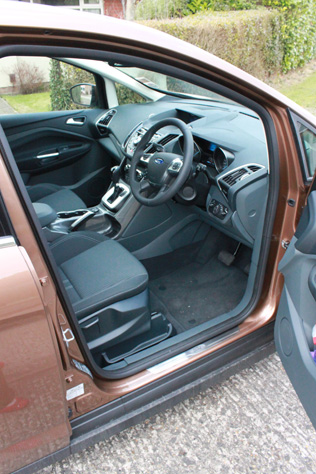
The height makes it much easier to get in and out

There are lots of things to make driving easier – like it parks for you automatically
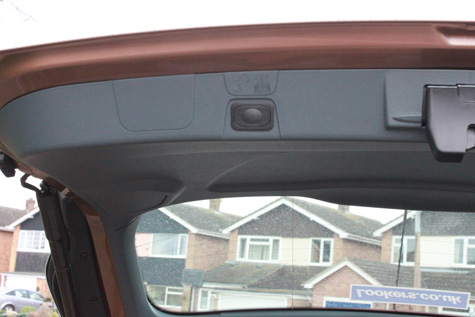
The boot opens and closes at the touch of button, which can be reached from the wheelchair.

The hoist for the wheelchair
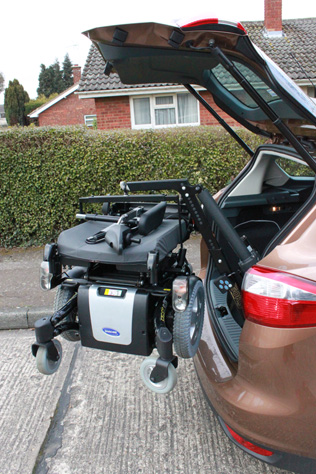
The hoist in action
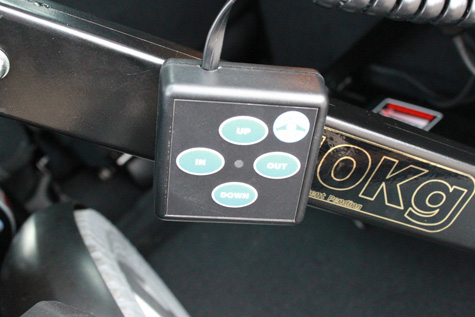
The new hoist has four-way control – which is great!

by The Chronic Chronicles | Feb 6, 2013 | Doctors
The letter from the Pain Clinic arrived today. Remember he’d agreed to say I needed massage treatment? It was the one silver lining of the appointment – so he can’t treat me, but at least I’ll hopefully get some help for massage?
HE DIDN’T WRITE IT.
Yeah, thanks. Helpful.
I then called his secretary, who asked him again about it for me. He came back (through her) to say he wouldn’t write that.
Credit to Catalin82
by The Chronic Chronicles | Feb 3, 2013 | Wheelchair
I had a lot of problems with my wheelchair, as I’ve spoken about before.
Luckily for me, my quest for a refund was successful. However, it then left me without a wheelchair for six months. I cannot begin to describe the frustration this has caused – taking away my independence. I haven’t been able to do something as simple as pop to the shop for six whole months.
You’d think getting a new wheelchair would be easy, right? Just a case of ringing the NHS and saying ‘Hey, I can’t really walk. Can you order me a chair?’ ‘Yes, no problem, we’ll get right on that.’
No.
No, no, no. That’s not how it works.
Okay, but social services must be able to get you one, right?
Nope.
Now, the NHS does have local wheelchair services. They each have different policies. My local one has a policy that if you can walk one step, one tiny, measly little step – you can’t have an electric wheelchair. You can have a manual chair though, even if you physically can’t push it yourself, and don’t have someone strong following you around all day to push it for you. So, to be fair – they did give me a manual chair, that sat dusty in my garage because I can’t push it at all, and my informal carer, my mum, has two frozen shoulders.
So then I looked for charities that may be able to help. None of my conditions have a particularly large charity, so that was out. There are a couple of children’s wheelchair charities – that go up to age 25/26 – but have massive waiting lists.
Now lucky me, I came across an answer – Access to Work! I’d just started a job, a year ago, when I made my application. I knew my wheelchair wouldn’t last, plus my needs had drastically changed – I needed something comfortable that fit my needs.
Now, I believe Access to Work is an amazing organisation that do a lot of fabulous work, but this whole process has been bogged down for ridiculous reasons. Basically, I have an adapted Motability car, and a wheelchair that would fit my needs wouldn’t fit into my Focus. It needed to be taller to fit a more robust wheelchair hoist in. And I needed for pay for it again, and pay for all the expensive adaptations, and I didn’t have any money.
So then started the biggest circle-jerk waste of time known to man. Responsibility was passed between Access to Work and Motability like the latest contagious virus. Neither would take control, both had the answer of ‘speak to the other.’ Hence why six months later when my wheelchair finally got taken back for a refund, I was left ANOTHER six months with nothing.
It wasn’t all their fault – it took ages to find a chair that fitted my needs, and ages again to pick a car that was right for me.
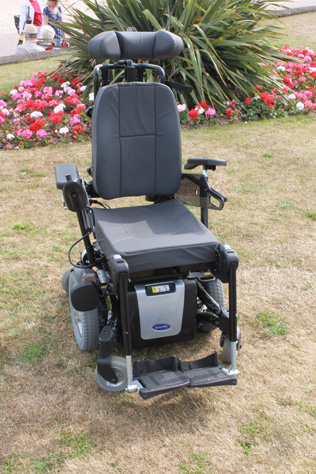
But enough with the whining – I now have a lovely, amazing wheelchair. It’s the TDX Invacare, and it runs like a dream.
The hoist lifting the chair
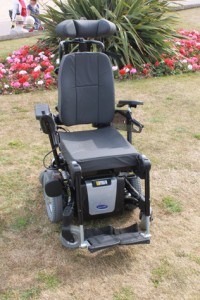
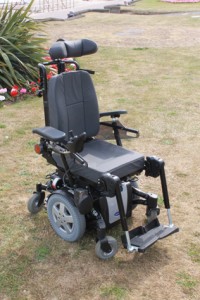
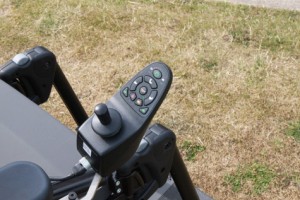
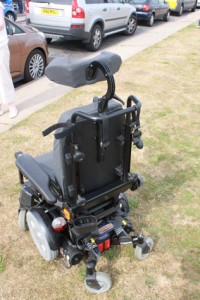
The bar handy to put hooks to hold bags.
I HAVE MY INDEPENDENCE BACK!

by The Chronic Chronicles | Feb 1, 2013 | Doctors
The day of seeing the Pain Clinic arrives. I have been researching latest treatments and I find one that seems really promising in terms of pain relief – infusions. I print off the latest studies to take with me.
I also take a list of medications/treatments tried and my diagnosis list. My mind usually goes blank when I’m asked, so it’s helpful to have to hand. My heart sinks a little when he asks about treatments I’ve tried – all the standard alternative and normal – physio/hydro etc and then follows up with ah, that’s a shame, you’ve tried everything I was going to suggest.
I want someone with flare! Imagination! Pain is unique and different for everyone, and if you can’t handle someone whose tried acupuncture already and found it unhelpful, then I’m going to struggle with that. So I bring him back to my main reason for referral – facet joint injections. My one last remaining hope.
But he, sadly, is not hopeful. He explains that normally they’d help (normally, normally – I hate that work. Normally surgery would work, normally treatment would work, but with you…) but because of my condition – my whole spine isn’t being held in place properly. If he injected the main site of pain, it’s highly likely that immediately the sites above and below would become the problem instead, so I’d want injections there, and then immediately the next sites would go… and so on.
I then ask about the infusions and he tells me they don’t do them there, and even if they did they wouldn’t be likely to do them to people with Ehlers-Danlos Syndrome as there’s so few of us. Right, so because it’s a highly undiagnosed condition – we deserve to be dismissed.
So my suggested treatment plan is upping my morphine patches until the highest dose possible. If I’m still in pain, then they’d look at the injections. Which will likely make me put on more weight.
The patches have added risks of fatigue, and messing with my hormones (i.e. increasing the acne I already have from using the patches.)
That’s it. That’s my whole treatment plan.
I then explain how helpful I find massage, but I’m worrying about how I will afford it when I finish work at the end of March. He agrees to write in my letter that I need massage as a treatment, which my GP should then be able to set up.
So, it seems this is my life. Painkillers on top of painkillers.
Credit to Kurhan

by The Chronic Chronicles | Jan 30, 2013 | Diagnosis, Doctors, Hospitals
The next step in my quest for facet joint injections, is my GP. But this time when I tell her what I need, she hesitates. Normally she would send me to the local Pain Clinic, but she’s aware my opinion of the clinic is somewhere around… mud. And that’s being polite.
But there must be other pain clinics, right?
So she has a look on the system and it shows a few I can pick from. There’s a hospital nearby with a reasonably good reputation, and she agrees to send me there. She tells me she’d be really interested to know how I get on with them, as it would be great to have an alternative to send people to. Translation: she has issues with the local pain clinic too, but can’t say so.
I’ve been seeing the pain clinic for some years now, and I have to say the treatments/suggestions they offer haven’t changed a bit. The latest medications, research and techniques don’t seem to reach them, so I’ll be really interested to see what the new clinic has to say.

by The Chronic Chronicles | Jan 20, 2013 | Daily Life
I can’t drive far, so it means my poor mum has to drive me to hospital appointments, and she HATES driving in central London. She’ll do it, unlike a lot of people, but it’s not fun.
It’s already a worry before we leave that we’ll get to the hospital and they’ll be no parking. This has happened loads of times before, and usually results in madness and mayhem. And that’s putting it lightly.
Picture this: last hospital appointment at the University College Hospital in London, which has six blue badge spaces. We’d been stuck in traffic and were now 45 minutes late for the appointment and of course all six spaces are taken. So we pull up outside, put the wheelchair together and mum sends me on my way while she goes to hunt for a space. Wheelchair battery promptly dies, so I’m having to use my feet to pull the wheelchair along (Fred Flintstone style) at 0.000000000001 miles per hour. I’m given the wrong directions and head to the other end of the department, before being sent back, and arrive at the nurses station way, way past my appointment time and promptly burst into tears and have a mild panic attack. Luckily, they took pity on me and they let me see the consultant at the end of his surgery time.
So parking, and being able to have someone with me? Helpful. Anyway, as a passenger in a car, I have an unfortunate issue of falling asleep. I’m generally close to exhaustion at all times, and there’s something about a car I obviously find soothing, as I can’t fight it and within a few minutes I’m usually out of it.
However, my mum struggles with the whole driving in London thing and trusting the sat nav, so I get woken up every 15 minutes with increasing franticness, “Which road do I take?” I mumble an answer, and then go back to sleep again. This apparently stresses her out, and she’d rather have an awake passenger when going to London. Whoops.

by The Chronic Chronicles | Dec 31, 2012 | Benefits
Imagine this scenario.
You’re need a job, but there’s a new system in place – in the form of one single interview.
You don’t fill in an application, or apply for a job that looks right, instead you sit in front of someone. They’ve never met you. They don’t have your CV, your history, your qualifications. All they know about you will be gained in the next few minutes and by looking at you. They ask you a list of questions. They seem quite irrelevant – none allow you to explain what skills you have, what your strengths are, or enable you to sell yourself. The interview ends, and there’s so much more you want to say, to explain. At the end they hand you a piece of paper with your job and salary on.
You splutter at the unjust nature – how they can decide what you can do without knowing your background, just by looking at you? They have no training in employment, or in your specialist area. Yet they’re deciding your future.
That’s exactly what happens when assessing whether a person with a disability can work or not.
The assessor is not usually medically trained. If you have a rare or complex condition, they won’t receive any information about it beforehand or speak to a specialist. They do not receive your medical record, any consultants letters, etc. They have set questions to ask they may have no baring on the condition. It does not take into account someone who may be reasonably well one day, and bedbound the next. Or the complexities of your situation, or the reality of your day-to-day life.
They judge you just by looking at you, which is difficult for all the thousands of invisible conditions out there.
And it’s just getting worse.
Thousands die each year after being found fit for work or other benefit cuts.
Would you want your life to be decided by someone who knows nothing about you? Who has no training? Just ticks boxes that do not relate to you in any way?
No? Then why should the disabled people of Britain face this?
Atos (Photo credit: Wikipedia)

by The Chronic Chronicles | Dec 16, 2012 | Coping Methods
A strong emphasis that seems to surround pain management and long-term conditions is acceptance.
It took me years to get to a certain level of understanding about what was happening to me. In the early years I spent literally thousands of pounds visiting all kinds of complementary therapists, buying supplements and trying the new fads. I was searching for a cure.
This probably lasted until I was diagnosed with a condition that’s incurable and so I had to adjust my thinking from ‘a cure’ to ‘management’ and also empowerment. I had to learn that my pain wasn’t going to vanish as soon as I found the some right type of massage, or the right acupuncturist. I had to try and take control of my own condition by trying to make the world fit my condition as best as possible. I had to say no to things I knew would impact on me, I had to find the right type of work, get the right kind of car, get a stick to help me walk, etc. I still continued the couple of treatments that gave me form of benefit, and stopped the others.
However, I still continued to hold on to some kind of hope. This was in the form of a particular issue with my lower back – which out of all the pain I deal with, and all the symptoms – the pain is my back is probably what impacts my life the most. It stops me sitting comfortable, and walking properly, and the pain is constant and severe. I begged for years for an MRI, or just for someone to find out why my back was so bad. It was different to the other general muscular pain, or joint flare ups, and finally I was given an MRI this year. This led to a referral to a spine surgeon who I saw last week.
The surgeon explained to be the damage in my spine is in the wrong place, and any surgery would just cause more damage.
I knew in my heart of hearts that would be the case from the research I’d done, and I smiled and nodded at him.
Yet, it hurts. I think I was holding on to a lot of hope that I would still get some kind of magical cure for my back. I realised when I was driving to work yesterday and my eyes suddenly filled with tears, because in many ways this is it. I really do have to come to grips with the acceptance milarky – with no ‘yes I understand this is it, but hopefully they’ll be able to help my back.’ There will be no cure. No treatment that will make it go away. No surgery.
It is simply about management now because that’s all I have, and trying to fight to right regime of medication, life-style choices and on-going pain management.
But it’s the fight, and the hope that keeps me going. I guess I just need to find the right balance.

by The Chronic Chronicles | Dec 15, 2012 | Opinion
Have you ever experienced a scenario where you’ve had a cold, a bad foot, or insert your own recent issue – and someone has said “have you tried taking Vitamin C?” or “have you tried daily stretches?” or “Have you tried being more positive?” or “You should just meditate daily. My aunt did that and her arthritis cleared right up.”
It’s often well-meaning or innocuous.
Now imagine you have a long-term chronic condition – of any kind. Think of that advice coming from your GP, your physiotherapist, your Occupational Therapist and your support worker. And then your aunt, your colleague, your friend, the waitress in the place you grab a coffee every now and then. And then… you get the picture.
And you heard almost every day, “Have you tried yoga?” “Have you tried cutting sugar out of your diet?” “Have you tried this new revolutionary herbal supplement?”
Those people still mean well, they want to help. In actual fact it can do just the opposite. It can be exhausting, frustrating, patronising or even rude. Sometimes you just want to vent – say ugh, I really can’t deal with this pain anymore. Often they just need some sympathy or empathy in return – not a suggestion to solve it, as it may simply not be solvable, or they can sort it themselves when they feel able.
The vast majority of people with ill-health goes through a long acceptance period. This can involve a vast amount of research, visiting many specialists, trying lots of treatments including many complementary therapies. They get to know their body, what is right for them and what isn’t.
Everyone is different, including people with exactly the same condition. For some people acupuncture may be fantastic, for the next it can be useless.
It’s a fine line – because sometimes someone may have a suggestion that will genuinely help, but please do think before you offer unsolicited advice to a chronically ill person.

by The Chronic Chronicles | Oct 30, 2012 | Diagnosis, Doctors
For so long now I’ve been trying to get an MRI, after my mobility vastly reduced over the past few years. Luckily my specialist consultant agreed, and asked my GP to get one done locally.
My GP told me it showed a few issues
- Limited marrow oedema (degeneration in the joint cartilage) in L2
- Moderate degenerative changes at L4/5 and L5/S1.
- Moderate sized disc bulge at L4/5 which along with ligamenta flava hypertrophy (enlarged connective tissue) caused by facet joint arthritis on both sides, which has resulted in acquired central canal narrowing (12mm instead of 16mm)
- L5/S1 moderate broad based disc bulge causing an indent in the thecal sac. This has reduced the central canal measurements from the expected 17mm, to 11mm.
- Synovial cysts are on both sides of the facet joints at L5/S1 level.
However, locally – I’m still getting nowhere. My GP referred me to a spinal surgeon to discuss this, but in my area we have a ‘spinal pathway’ – seemingly controlled my physiotherapists. Even having my results upfront, they still want a physiotherapist to carry out a physical assessment, which isn’t going to tell them anything!
After waiting eight weeks for this, I went back to my specialist consultant at the Royal Orthopedic Hospital, who agreed to refer me to a surgeon there, so I can actually discuss my options (if any).
But, it at least explains why I can’t walk far – both the spinal narrowing, and facet cysts would cause this issue and can’t be solved with the hand wave ‘just exercise more’ than doctors love.
English: MRI sagittal image of sacral and dorso-lumbar perineural cysts (Photo credit: Wikipedia)

by The Chronic Chronicles | Sep 10, 2012 | Diagnosis, Hospitals
I was told me to get to the hospital at about 5 to prepare for my MRI at 5:25pm.
I immediately began to be concerned – I was having a high pain day, and one problem with an MRI, for those who are new to them – you have to keep completely still. If you move they will start the whole thing again. And anyone who knows me (or anyone with chronic pain!) will tell you – I can’t keep still. I personify a fidgeter.
I took every painkiller I could, and arrived at 5pm, parking in a blue badge space next door to the MRI centre, which was a great bonus as they were normally full. This meant I didn’t have to faff around getting my wheelchair out, as I was literally two steps away.
I was given paperwork to fill out, and immediately had to answer yes to a ‘red flag’ question – are you wearing any medicine patches? The lady informed me I would have to take it off. Oh. You mean the patch that was brand new on that morning, that’s meant to last me another four days and if I take it off means I will run out of patches four days early, causing mayhem to my delivery system, and will leave me without lovely morphine pumping through me at a time I need to lay down for half an hour and keep still? Apparently one person once had a reaction and it burnt her, so they now have to be taken off. I’m not moaning at this policy – I just wish they’d have mentioned it as I would have held off putting it on and wasting £70 worth of patch.
I’m then informed I’m in the mobile scanner, which is on the other side of the car park. At the look on my face, the receptionist kindly offers to call me a wheelchair, and I take her offer thankfully. At 5:30pm a lady arrives, who has a limp, and is told she needs to find me a wheelchair. She returns dragging a battered looking thing which she can’t get to move. She limps off to find another wheelchair in the hospital – and returns with a chair that needs to be pulled backwards. The rain is now pouring down, and I look longingly at the people going into the next room for the MRI as I’m pulled out the room backwards, by a lady who looks like she needs a wheelchair too, into the wet, cold car park.
We don’t make it very far – she pulls me straight into the tunnel that joins the two parts of the hospital up, and then says she is going back for an umbrella, and leaves me. A grumpy looking security person comes along and closes all the doors around me, before I can protest. Limping lady arrives back and isn’t happy that she now has to try and get a wheelchair through a couple of sets of closed doors. Her umbrella blows inside out, and she gives up. The receptionist appears and takes over the pulling duty, and they take me to the other side of the hospital. Lucky for them – I can walk a few steps, because the mobile unit they have sent me too isn’t accessible. I’m told to stand on a lift in the pouring rain – which isn’t big enough for a wheelchair, and they send me up. I get even more soaked and cold while she shouts through to the other side to try and explain how they open the door to someone who can’t find the button.
I’m shaking by the time I get seated next to the person taking images, and can see the outline of a pelvis on the screen. They are all sitting in coats, and look cold and bored. I’m nervous – I’m soggy and about to go into a big electrical machine, but the lady assures me it won’t electrocute me! I’d spent the afternoon putting together a ‘relaxing music for an MRI’ CD to try and drown out the noise, so I get it out, but they tell me the CD player is broken. I’m struggling to breathe by now as panic sets in, so I puff on my inhaler before they take my bag away to lock up, and I take my patches off. I’m not scared about the MRI itself – just worried about them having to restart because I move. The other lady finishes and is getting dressed. I’m aware of this as the porter walked in on her doing so without knocking.
I’m ushered in next, although I’m told I can’t take my stick in and will have to use the bed to lean on – which is too low to be possible. It’s small and cramped. The lady with me doesn’t really speak English very well, and waves at the bed, and then raises it until it’s much too high for me to get on. She then sighs and says I was meant to sit on it first, but I hadn’t caught on what the random wave towards it meant. I have to take off anything that includes metal – but luckily I dressed to avoid zippers, etc. She tells me to lay down and put the ear plugs in. Every time I put them in, she then asks me a question – so I have to take them out, only for her to be asking if I’m ready.
She sends me through into the narrow tunnel, before she stops and says ‘Are you arms touching the sides? They are. She seems concerned, which makes me concerned – but she says, ‘Oh, I’m sure it will be fine. Just hit the emergency buzzer if you feel anything.’ She then leaves, and I’m wondering if I feel what?
A voice comes over the intercom to say they are starting, and I cannot move. I’m completely tense – they haven’t given me more than a couple of seconds to try and relax out and get into a comfortable position, and it’s off before I can do so. I then have to maintain the completely uncomfortable position – my muscles trembling and spasming, in my fear of moving and making them restart, therefore prolonging it.
I’m also worried about my arms. The time before I had an MRI I just tried to daydream, but this time my focus is on where my arms are touching the top. As the tube begins to warm naturally – as anyone would in a narrow tube, I worry about her definition of warm. Does she mean any kind of warmth, or if I actually feel it start to burn? I get hotter and hotter in there, probably as I panic.
I’m so glad when it’s finally over. They drag me back to the MRI centre in the backwards wheelchair, and leave me to get back to the car. Unfortunately I’m left feeling so dizzy, sick and in agony, I shuffle back to the car and almost collapse in. I’m left in excruciating pain for the night, even after replacing the patch.
So, that was my experience of my second MRI. I just hope it’s all worth it!
Next up: the results are in…