by The Chronic Chronicles | Sep 9, 2012 | Diagnosis, Hospitals
The first part of the story can be found here. From 2008 onwards my mobility vastly decreased. I swiftly went from sticks, to wheelchairs, to sometimes a few steps being too much. The chiropractor I was seeing at the time advised she thought my facet discs may be getting worse, but wasn’t entirely sure.
By this point I had a diagnosis of Ehlers-Danlos Syndrome, was aware one of the issues is that it causes joints to degenerate a lot quicker than they should as they are hypermobile and moving out of place all the time, which then in turn causes them damage. So it’s sensible to keep an eye on it, as you could technically end up crumbling away!
Last year I brought up this issue to my GP. While I understood and generally accepted the condition, and the general levels of constant pain, I was worried about what was going on in my lower back which has been the worst pain I have for some time. She agreed with me it was a valid concern, but said she did not have the authority to send me for an MRI unless it was for a surgical reason. I pointed out that I was unsure if it was surgical until it was scanned, but as she could find no symptoms relating to a disc pressing on a nerve – which is not my worry anyway, there was nothing she could do.
Instead she wrote to my two EDS specialists. One my specialists I really like – he listens in appointments, and makes lots of referrals. The other one comes across as slightly dismissive, and mostly spend her time trying to get me to lessen my painkillers – which wasn’t going to happen, after finding my current regime the best I’ve had so far. The problem with the first specialist is that he doesn’t seem to respond to GP letters. I realise he’s busy, and should have retired years ago – but local doctors just don’t have the skills and knowledge to treat EDS most of the year, and we shouldn’t have to wait for a check up just to get a simple question answered.
The second specialist did come back, however – to say she felt the answer to my issue was exercise. I have to say my letter back her from my GP and I wasn’t particularly polite. Oh, exercise! Silly us! I’ve done all the bloody stretches and exercises they have given me, and it’s ten years later and my lower back is simply getting worse. This is not an issue to simply dismiss as ‘have an exercise sheet.’ I have to say all my trust in her immediately evaporated at that response.
My GP then tried again to a local Pain Consultant. I have to say I’ve never liked this pain consultant. I saw him before I had a diagnosis, and he seemed to immediately take against me because I’d already tried the suggestions he normally makes to patients (acupuncture and a TENS machine… Yep, that’s it.) On my first appointment I asked him if he thought it may be Fibromyalgia, and he responded, “You can call it that if you like, but I don’t as it’s too American.” On my second appointment he said I was on too many painkillers, and that I needed to come off one of the painkillers. On my third appointment he said I wasn’t on enough painkillers, and upped my morphine dose.
But I still wasn’t expecting the response I got back from him that stated in black and white that to give me tests/injections into my spine would be “medicalising her condition, when she should be seeking psychiatric help” or something to that effect. He also seemed to have forgotten I have a diagnosis Ehlers-Danlos Syndrome, and stated my condition was Chronic Pain Syndrome instead.
Luckily, my follow-up with the first specialist was due a few months later – and he agreed with me I should have an MRI, as we don’t exactly know what the issue is – whether it’s something that’s got worse, or something new. The bad news is that they are transferring existing EDS patients from my preferred hospital of UCL London, to Stanmore – therefore losing him as my specialist, and making the other one my primary.
Two weeks ago my GP phoned to say now that my consultant has agreed in regards to the MRI, I can now go on the waiting list! I wasn’t sure how long they were taking, and hadn’t heard anything when couple of weeks ago I received a phone call from the MRI department asking if I was aware I had an appointment in a couple of hours, as I had yet to confirm it. Um, no, I certainly did not. I thanked her profusely for calling me, if she hadn’t I would have gone down as a Do Not Attend – and gone to the back of the waiting list at best, discharged at worst.

by The Chronic Chronicles | Sep 8, 2012 | Diagnosis
My path to a diagnosis was a long one.
I seem to have had a few people in my life at the moment develop back issues. In all, or at least almost all cases they seem to have gone to their doctor, been sent for an MRI, been diagnosed and sent for treatment. That’s brilliant, exactly how the NHS should be.
That’s not how it’s been for me. Sorry to bore those who’ve heard this before, but 10 years ago I started to get a strange pain in the joint between my neck and spine (that one that’s a little bump.) It began to crack, and feel really stiff. The pain spread into my shoulders and upper back. It then went into my lower back – badly. I began to not be able to stand as long as I used to, or sit comfortably. I fidgeted constantly, and my joints all began to loudly crack all the time. I didn’t know what the hell was wrong with me. The first rheumatologist I saw said I’d grow out of it. The second said it wasn’t arthritis, but didn’t know what it was. The next said I had bad posture – ignoring the fact I was hunched over due to the pain.
In the years between 2002 and 2008, that pain spread into every joint, every muscle. The fatigue was getting worse. I could only walk for short periods of time. I saw rheumatologist after rheumatologist, and two different pain consultants. Each time I raised the possibility of an MRI, but it was dismissed.
I finally saw a third Pain consultant in 2008. He was an asshole. It was the first time I left a consultants room in tears. He told me there was nothing wrong with me, and he said he would prove it by sending me for an MRI.
I was pissed off, but also pleased. At least his bad attitude was getting me an MRI. When I returned I saw yet another pain consultant who told me the MRI “showed nothing.” I was very disappointed. It’s very hard to be in constant pain and have no idea why. You hope it does show something – because at least you know, and then you can look at possible treatment options.
I continued to see the spinal specialist physiotherapist at the hospital who was able to print a copy of the MRI off for me. The same physiotherapist who said, “You are hypermobile as hell. I can tell just by looking at you.” She didn’t help me physically, but she tried – and helped point me in the right direction of my final diagnosis.
Unfortunately, despite having a copy of the MRI, I didn’t understand a word of it. A few months later I sat, although I can’t say why it took me that long, I sat googled every single word of the MRI that ‘showed nothing’ and was surprised to find various disc bulges in my lower back and neck, quite bad facet disc degeneration and arthritis in my lower back. So there was something. It might not have been the worst MRI he’d seen, or not operable – but I believe I should have been told what it did say.
From 2008 my mobility continued to go downhill, first causing me to walk with a stick, and later needing a wheelchair more and more often. My lower back continued to decline; at best feeling like someone was gripping into it, crushing and aching. At it’s worse? Well, there aren’t really words. I was desperate to find out what was happening, but it took another four years to get that update.

by The Chronic Chronicles | Aug 28, 2012 | Wheelchair
Credit to Catalin82
In July I got a new wheelchair as I posted about here. Sadly, it hasn’t gone so well and the company I got it from have been awful. I have phoned, written and begged the company for a replacement for over a year. Last night I post my temper and wrote to the CEO of Betterlife Healthcare. I hope this gets an answer. If it doesn’t – it made me feel a little better.
Dear Mr Abrahams
I am writing in regards to the on-going saga which can be summed up by the fact in July 2011 you sold me what you define as an ‘Aries wheelchair’ and I define as a ‘useless piece of rubbish that regularly breaks down, or regularly has pieces falling of it – interspersed with the most appalling customer service I have ever received from a company’.
First of all, I’m not sure if you’re aware, but people who generally use wheelchairs either can’t walk, or find it difficult to. We generally rely on them, and find them quite important in our lives. I get the impression from your company you don’t understand this vital function by you way you have treated me over the past year, so I just thought I’d clear that up for you.
On to the point of this letter – one of the many letters, emails and phone calls I’ve had to make over the past year. I agreed to you taking the chair away for an inspection, despite having taken a day off work a few weeks ago when you sent a technician to carry one out – who then took photos for 30 seconds and then left – with no report forthcoming. So I agreed to another inspection only on the proviso I was given an alternative suitable chair.
First I was called by someone who said they were bringing a scooter – I’m unsure if it really was a scooter, as so many members of your staff have an incredibly annoying habit of calling wheelchairs scooters, which is a shame because I would have thought as a mobility company you might be aware of the differences between the two just by looking at them. Silly me.
I explained I did not want a replacement scooter, but a wheelchair, but the lady then came back to say I could have a loan chair, but it could only be used indoors. That obviously did not meet the definition of an ‘alternative’, just as if I was offered a loan car but was told I couldn’t leave my drive way, then eyebrows would clearly be raised. The weird thing about wheelchairs is that you generally use them to leave the house, so I declined this ludicrous offer.
My next offer was a specific wheelchair that I was given the name of. As my trust with your company is on a par with the countries feelings towards the banking sector, I decided to google this before accepting. I immediately noticed the weight limit of the wheelchair did not meet the accepted level I had just informed you of 30 seconds ago. I was then told there was no other alternative, so we were left at stalemate.
My mum then decided to help me by contacting a manager at your company, Heather, to try and address this, and Heather promised a suitable alternative would be given that could in fact leave the house, met the weight limit, and go into a car. Great! Except this was the same Heather who twice promised me a replacement chair, then denied all knowledge and said I was lying when it came to actually obtaining said replacement. So again, my trust? Bob Diamond level.
The technician came today to pick up my sorry state of a wheelchair, which currently looks like something that’s had a very hard life – with all four tyres going flat despite regularly pumping them, the replacement footplate not clicking into place, the glue or bolts holding the side of the wheelchair in place having fallen off – leaving both sides flapping, and just to top it off – as the technician lifted the chair, something else fell from it, like something out of a comedy sketch. Except I don’t find it funny.
He then handed over a wheelchair – a rickety looking thing with a big split across the headrest and left. Firstly, it wasn’t charged – which means I won’t be able to use it until tomorrow, which seems really rude of you – but I suppose a blip on the radar at this point. Worst of all – it’s that specific chair I declined. You know, that chair that doesn’t meet the weight requirements?
I used the last drops of the battery life to take it to the back of the house, as it wobbled away, and theb tipped as I went round the corner but was luckily saved from falling by my mum. So that ‘replacement’ chair can’t actually be used as it’s yet another completely pile of rubbish, which I suppose I was expecting from your company.
I’m tired of emailing or phoning you begging you for a refund, saying I’m ‘shocked and appalled’ with your service and unhappy that I’m housebound as I wait yet another repair on the chair. I oddly enough have better things to do. So here’s a suggestion: just give me my money back so I can get a replacement chair from elsewhere, and you can carry on treating your other customers with contempt.
Yours sincerely
Jade
Edit: I got a response the next day offering a refund! I went back and requested some compensation for all the injuries and suffering caused, and the times I’ve been trapped indoors for months on end due to the wheeelchair breaking.
He came back to offer 10% off my next wheelchair from them. Needless to say – I said no.
by The Chronic Chronicles | May 27, 2012 | Access, Education, Vents, Wheelchair
Credit to cuervo
Sometimes I have those days – although in my case, it always seems to happen in the middle of the night. One of those oh god why does nothing go right things?
Sometimes I’m not sure why I’m so anxious, and why somethings become such a big deal. I’m currently trying to get my wheelchair replaced via grants, and in my desperate research to find any organisations that may actually give me any help stumbled across some research that showed people with Ehlers-Danlos are highly susceptible to miscarriage. It’s not like I’m anywhere close to having a child, or even know if I will have them – but if we didn’t have enough against us having children already. First is the high chance of giving the kid the condition in the first place – and it possibly being the ‘die early’ type, not just the painful type. Then there is the possibility of my hypermobility vastly increasing during pregnancy – to the point of constant dislocation, and issues giving birth with the pelvis. Then there is the issue of having to give up the morphine for nine months, or have the child be born addicted to drugs and have to spend the first few weeks going through withdrawal in intensive care. So the cherry on the top is that there is a good chance the baby won’t survive anyway. Fabulous. I don’t mean to feel sorry for myself, but I’m still learning so much about this condition. I’ve only been diagnosed with it for a year – and am still getting to grips with how it all works.
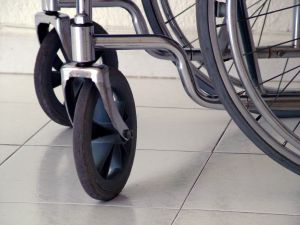
Then back to the wheelchair. I bought this chair in July. Well, when I say I did – actually some members of my family clubbed together to buy it for me, but we made the error of buying it from Betterlife Healthcare – a company we now know to have appalling customer service, questionable ethics, and a very much ‘we don’t care your wheelchair is a pile of crap’ attitude.
It’s brilliant to have a chair that jams on everything going, let me tell you. I particularly loved in when my chair stuck fast on the flat ground when coming out of a church, with 200 wedding guests behind me. Or when my mum tried to unjam the chair in a shop, and the footplate came free so quickly she fell on the floor and her arms and legs were covered in bruises. Or when I left work the other day to pop to a shop and it jammed on a flat pavement – and an 85 year old in a wheelchair, with an oxygen tube, had to stop and help me!
And yes, we’ve complained. Their attitude can be summed up with ‘haha, we have your money, now go away.’ I don’t actually want a refund, I want a replacement – because a refund will leave me without a goddamn chair, and it was so incredibly hard to find a chair that met my requirements in the first place (and I promise it was basic needs, not ‘it must be glittery pink’.) I have searched for a new chair, but the next type that meets the standard of being light enough to lift into a car and foldable seems to jump up by about £4000.
Then I found this charity called Action for Kids, which despite its title is meant to offer help getting a wheelchair for up to 26 year olds. I contacted them months ago, and was promised a visit which has yet to occur, despite constantly chasing them. When I phoned to find out their requirements they seemed very confused, and they gave me an extensive medical form to fill in – of which listed only very specific conditions and total paralysis were mentioned, which is very confusing because people with those conditions would qualify for a wheelchair from the NHS as they would be totally unable to walk.
Oh yes, did you know the NHS has a wheelchair service? When I first was referred for chair a few years ago their policy for an electric wheelchair was that you had to use it indoors and out. As I lived in a postage stamp house I couldn’t fit a wheelchair in it, so that ruled that out and they gave me a manual one instead. This was great, except I manage about a quarter of a turn before my shoulders and arms go into spasm, and don’t recover for about a week, which meant mum was forced to push me, which is not easy. You think the world is wheelchair accessible? There isn’t much I can say, other that it’s not.
So then we skip forward to buying the crap electric wheelchair, and it constantly breaking down. We then moved into an accessible bungalow and I am now having to use the chair a lot more now, even in the workplace. So I contact the NHS again and they inform me the policy has changed – they now only give them to people who cannot walk a step. Ever. I explain I cannot use a manual wheelchair. She’s sympathetic. I tell her my mum has damaged both her shoulders from pushing the chair, and lifting it in and out the car. She’s even more sympathetic. Then she tells me tough luck, policy is policy. Okay, she didn’t use those words – but it was implied.
And so I am here with a wheelchair which currently has no footplates. I got replacements a couple of weeks ago, but they both snapped off last week. On even ground. Action for Kids implied it would be months and months before I got near the top of the list, plus they judge you on whether you actually deserve a wheelchair (i.e. not on medical grounds, but there is a section on why you think you should be given one).
The warranty for my chair runs out in July. If I ask for a refund for the chair I will struggle to work, run the access group, or go out anywhere. If I don’t I’m stuck with it forever.
I need to apply for grants, but I just don’t have the energy at the moment.
I kind of need a shoulder to cry on right now, as it’s all a bit overwhelming, and at the same time I need someone to say oh pull it together and stop whining, you aren’t having babies any time soon, and it’s just a fricken wheelchair!
Yeah, it’s one of those nights.

by The Chronic Chronicles | May 23, 2012 | Coping Methods, Vents
If you ask a doctor how to care for a chronic condition, or read their guidelines, or even go in hospital for a month on an intensive-pain management course (just to be specific) the themes running through them all, their little buzzword, is self-care.
I was reading the papers that have been created in the wake of the imminent closure of the PCTs by the doctors commissioning consortia whose priorities for the future are self-care, with aims to give patients the confidence to manage their conditions themselves.
To be fair, this may help with some conditions where perhaps a specific therapy or medication keeps symptoms at bay, but it gets a little more complicated when it comes to complex conditions where pain and fatigue are two pervading symptoms, amongst many others, because there is no single treatment. There isn’t even ten treatments they can say hand on heart would help everyone with chronic pain.
To be frank, it infuriates me to hear phrases such as ‘take control of your own treatment’ or ‘You have the power in your hands’ etc, etc, blah, blah, blah.
What they don’t tell you is that you have to. Self-care, that is. Because it will make up 99.9% of your overall treatment plan. Oh, it may be occasionally the NHS will think of something – physiotherapy injections, uhh… more physiotherapy, that is if you kick up enough fuss. Otherwise, it’s DIY all the way.
At the age of 15 I visited a Rheumatologist. He said I’d ‘grow out of it’. In the following years I was sent a couple of times for Physiotherapy, but it didn’t make the slightest bit of difference. The NHS then gave up, and in desperation I saw chiropractors, osteopaths, acupuncturists and electro-acupuncturists. I tried the many sheets of exercises and stretches, swimming and pilates and a GP referral to the gym (that I paid for) which put me in bed for two weeks. I then started the ‘alternative’ stuff like the Alexander Technique to improve posture, the Bowen Technique which seemed weird and pointless. I saw Kinesiologists and had relaxation sessions. The only tiny bit of relief came from the many thousands of massage treatments I once again paid for.
I’ve researched madly, kept up to date with papers on pain, studies on medication, and constantly visit the doctor with a new research paper in hand.
I even diagnosed myself – after years of consultants shrugging their shoulders at me, I kept searching and searching until I finally realised what was wrong with me, and then fought to see consultants in London who finally knew what they were talking about.
I now can only exist and function from a mixture of massage and adjustments, which takes the edge off – maybe 5-10% at best. But it’s an important percentage.
In the ten years I’ve been madly trying anything and everything, the NHS gave me one set of facet joint injections in 2008. Some muscle injections in 2011. And six sessions of Hydrotherapy – but I had to fight for them all.
The thing I find infuriating is that no one tells you exactly what IS available. I had severe back problems for ten years before someone said to me there was a spine clinic in my town for people with long-term back issues. Do you really have to hit the ten year mark before they go crap, that is long term for a twenty-four year old?
When you get a diagnosis no one gives you a handbook and says here is what the Pain Clinic offer (if they deem you lucky enough to offer you anything at all) or let you know you can see Osteopaths and Chiropractors on the NHS. Or any other of the treatments they may have available. You have to wait until you stumble upon it yourself.
All they do is hand out painkillers (again, if you are lucky) and tell you self-care is the way it should be.
Sometimes I want to say you know what? I’ve self-cared. NHS – it’s your goddamn turn. I’m just too tired.
by The Chronic Chronicles | May 22, 2012 | Daily Life
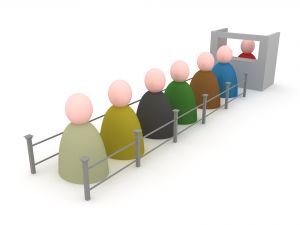
I see a queue and my heart sinks. Nothing to do with impatience, or having somewhere else to be. Nobody likes a queue, but I hate them.
Do I really need to stay and pay for this item? I’ve used so much energy getting here, getting the item. The place wasn’t wheelchair accessible, so I’d made the gamble: to do the shop race. Get in, grab item, get out. It’s just a small shop, so no trailing down aisles.
I’d got the first parking space, dodged the people milling around, and found the item I needed in record time.
Then I turned the corner and saw the queue.
My heart drops. I want to leave, but I really, really need it. It can’t wait. I have to get it today.
So I join the queue with trepidation. And immediately it begins – the ache intensifies, solidifies into an unmistakable gnawing, right in the bones.
I eye the people in front of me, judging them. That one’s near the front and hasn’t even got their purse out, one of the cashiers yawns. Hurry, hurry, I plead. But they continue leisurely, with all the time in the world.
The pressure begins, and I’ll soon by at my point, my limit. I begin to sway from foot to foot, trying to ease the pain. But it builds, and they continue to amble on.
I begin to plead with them in my head. Please leave the queue. Please see I have just one item and let me go first. Please.
I know this won’t happen – why should they? They are in front of me, it’s first come, first serve: the British way.
I feel sick. The pain is intense. Like someone has their fist around my spine and delighting in crushing it, bit by bit. It travels up into my shoulders, getting tighter and tighter, into my legs, my feet.
Just one more person and I’m at the front. Then they head towards one of the cashiers, but it’s a complicated return.
And then it’s my turn, oh thank goodness, I take a step towards the second cashier, but he stands up with a shrug and declares himself closed. I want to cry after him, no, please… He instead heads towards some children milling about by a second counter to serve them. They don’t even care, they seem annoyed he has interrupted their conversation.
The other cashier is still wrapped up in the return. I can’t breathe. Tears sting my eyes – over a goddamn queue.
I’m shaking. Why did he leave? He could see my stick, surely he must have seen my pain? Why isn’t pain visible – it would make life so much easier. They give us parking spaces closer to the shop, but queues are just tough damn luck.
Finally, it’s my turn, for real this time, and finally I can limp back to the car and collapse with relief. The pain stays for days.
I hate queues.

by The Chronic Chronicles | May 9, 2012 | Education
What do you think of ME? That condition people have when they don’t want to work? Yuppie flu? We are all tired – so stop whinging?
The medical community and the media has portrayed a certain image of ME that doesn’t live up to reality. Did you know ME is actually a neurological condition similar to MS? That people regularly die from it?
Some years ago the condition was renamed in some circles as ‘Chronic Fatigue Syndrome’ and pedaled as a mental illness – which couldn’t be further from the truth. Many activists are now trying to divorce the two conditions. Chronic Fatigue seems to be a catch-all for long-term fatigue to which no other cause can be found, yet ME is testable, and so much more than fatigue.
I don’t normally link to The Mail, and in some ways I find this article funny, as they probably wrote 90% of the articles calling people with ME lazy, job-shy malingerers, but it’s a good look at the myths of ME.

by The Chronic Chronicles | Mar 27, 2012 | Access, Daily Life, Trips Out
One thing that still bothers me after all this time of having mobility issues, is the problems that visiting new places brings. I’ve just spent the weekend in London as a birthday/Mother’s Day treat for my mum.
Trips like this involve a lot of planning. One particular issue is finding close parking, but it’s pretty hard when London’s involved as it’s such a maze. Even having parking near enough doesn’t mean there will be dropped curbs, or that the wheelchair won’t get stuck, or the battery won’t run out, and many of these issues you can’t plan away.
On Sunday we went to the Ideal Home Show. Online a ticket was £14, but because we needed a carers ticket, you couldn’t purchase it in advance so we had to pay on the day – now £18. (Strike one!)
The Earls Court website informed us there was plenty of free blue badge spaces close to the entrance – great! This helps with the dropped curb issue (which doesn’t just happen in the middle of nowhere, it happens all over the place.)
We arrive to find a whole row of blue badge parking, except every single one is cordoned off. Not filled, which we’d just have to live with – just roped off for no reason. The car park is available though, they tell us with a smile, but it charges by the hour. Having a wheelchair takes a lot longer to get round things, so that added an extra £25 to our day. (Strike two!)
Credit to: edouardo
The car park is at the back of the building – so getting to the exhibition was quite the trek. (Strike three!) It would have been totally impossible without the wheelchair, so how ambulant disabled people coped, I don’t know. Actually, I do, having been to The Back Pain Show at Olympia recently, the same company as Earls Court, we found the parking at the back of the building and having to pass two other exhibitions to get to the right entrance, once of which being a wedding show. I’m not saying disabled people don’t get married, but one assumes more disabled people will be heading to the show about combating pain. We were hiring a wheelchair at the exhibition, but they hadn’t thought about bringing it round to us – so by the time we got there I was almost throwing up in pain.
Back at the Ideal Home, my wheelchair battery was playing up, and by the time we made it from the car park all the way there, I only had a tiny bit left. We headed straight to the top floor for lunch, as I worried about how the hell we were going to get around with minimal battery. We’d bought the charger with us, in case there was a spare plug, but they were all up too high to reach.
We spotted a tea room style area for lunch, and headed over. There was plenty of free tables at the back, but when I asked if there was a route for wheelchairs, we were met with a blank stare and told it would be a half hour wait for a table we could get to. (Strike four!) Instead we headed to an Italian styled cafe, which sold nothing Italian. We shared a sandwich, one packet of crisps and a drink each for £15. Ouch.
The layout of the exhibition was pretty good, with enough space to negotiate and view the stalls. A kind stallholder allowed us to charge my batteries while we tried out some pain relieving equipment.
I do have some rules regarding navigating with my wheelchair. It’s actually quite hard to steer, so I really appreciate those that step out the way. I really do. I avoid people as much as possible of course, and I do my best to halt for children. However, if you stop dead in front of me, or walk backwards into my path – you are fair game. Be warned. Plus, nobody needs to walk backwards, so why do so many people do it?!
Even with the space, having to constantly stop for people and wait to look at things, it took pretty much the whole afternoon to get around the top floor. By the time we got down to the actual ‘home’ section, we only had forty minutes to go. To be fair, we don’t have any money and don’t own our home – so kitchens, bathrooms, etc don’t interest us. And no, I don’t want to buy any goddamn solar panels.
The show homes were not wheelchair accessible, and seemed to only be accessed by stairs, which was a shame, as I’d have been interested to see them. (Strike five!)
We were both pretty exhausted by then, and tried to head to the exit. After going round in circles, we asked a member of staff the way out – one of which who grunted and pointed to the lift. We got out at the next floor after getting the wheelchair jammed in the lift due to it not stopping straight, which broke my footplate, only to be told we’d been on the right floor previously. The next member of staff we asked pointed vaguely, and again was wrong, and when we finally found the exit no one was there to operate the stairlift. When we called for help they said we had to find another exit. (Strike six!)
All in all – a tiring day, that wasn’t worth the money we paid, although we got some interesting bargains whilst in there.
Above all, I was disappointed such a big organisation hadn’t thought more about accessibility. Signs to the exit and signs for wheelchair access would have been helpful, and why an earth did they prevent access to so many disabled bays? Staff should be trained better as well. Lower-cost parking for blue badge holders would be very appreciated – many of us don’t have a choice but to drive there, or not come at all.

by The Chronic Chronicles | Mar 8, 2012 | Access, Employment/Work
My job offer is now formal – I’m so pleased.
I have a lot on at the moment. Our local council has decided to remove access to all the central, level blue badge spaces in the town centre and add more to the existing car parks on the outside of town. They are much too far for disabled people to walk to. For over a year as chairperson of the local access group we’ve been fighting the decision and trying to get them to come to a compromise, but they haven’t been interested. Yesterday they published the official order to make the changes, so I’m madly working on a response to the formal consultation.
My wrists have chosen now to flare up as well, which is making life quite difficult.
Credit to: Michel Meynsbrughen
www.prestonotes.c.la

by The Chronic Chronicles | Feb 10, 2012 | Daily Life, Education, Opinion
Ron Liddle from The Sun wrote a column condemning the ‘fake disabled’. He says, “My New Year’s resolution for 2012 was to become disabled. Nothing too serious, maybe just a bit of a bad back or one of those newly invented illnesses which make you a bit peaky for decades – fibromyalgia, or M.E.”
Peaky? This describes people that often become totally bed-bound, are in crippling pain, too exhausted to lift your head off the pillow or have to use a wheelchair. ME regularly kills people after ravaging their immune system, although the press keeps quiet on that. People don’t speak of the young people having to live in their beds due to the pain Fibromyalgia causes.
Another charming person, this time James Delingpole from The Telegraph, writes in support of Ron, claiming that there are eleven million people now saying they are disabled, and this it what’s crippled the economy. Eleven million disabled people there may be, but only 2.6 million claim Employment and Support allowance, the ‘not able to work’ benefit. The other 8.4 million actually work. Crazy, I know! (No reflection on those that can’t work meant, just that there is an assumption that disabled people don’t partake in employment.) It may be many people now fit the definition of disabled, which is ‘A physical or mental impairment which has a substantial and long-term adverse effect on a person’s ability to carry out day-to-day activities’ but the vast majority of disabled people try their best to work.
Another couple of points on these multitudes of disabled people crippling the economy is that Employment and Support Allowance is around £97 a week, and if your partner earns over £5343 a year you get nothing. The governments own figures put the fraud rate for ESA at 0.3%. The fraud rate for Pension Credit is 2.3%, but nobody seems to mention that. They are also bringing in a change that people can only claim contributory rate ESA for a one year. After that year they’re means tested, with a limit of £6000 in savings.
There is another disability related benefit – Disability Living Allowance, that is frequently used to support working. The extra costs of being disabled is significant. Equipment costs a fortune, needing transport on every journey soon adds up, treatment that enables you to work is often not covered on the NHS, heating for those with joint issues, extra cleaning costs, heat pads and so on. So this benefit is often used to pay for all those bits and pieces, or actually extremely important functions that allow people to work, and as a result pay taxes.
This is having a real impact on people’s lives. The suicide rate is constantly increasing and if the changes to DLA go ahead – where one suggested option is to remove the mobility allowance from wheelchair users with the idea a wheelchair makes someone independent, this suicide rate is going to vastly increase – no doubt about it. That ‘free car’ often complained about is something where you can cash in part of your allowance in return for a leased car. This allows people to have low-cost adaptations and transportation that meets their needs. The adaptations I needed came to a few thousand pounds, and really the adaptations didn’t amount to that much.
DLA is incredibly hard to get. The stress and torment people have to go through to get it is indescribable. People with terminal illnesses get turned down. This is why the fraud rate is so low. Yes, of course people will always slip through the cracks – it’s easy to lie about something that isn’t personal to you, and even suck doctors in with it. And these are the other that papers scream about, this 0.5% that makes the news daily – Scroungers! Work shy! Liars! They don’t point out the 99.5% that are genuine.
I’ve just spent three weeks with many chronically ill people, most with multiple painful illnesses, and the vast majority of them worked full time, way past what they should have done. Many volunteered on top of that work, others were carers for other people. Hardly any of them were on the benefits they should have been and were struggling financially. Many had been awarded DLA at a very low rate, when they should have been entitled to a much higher rate, but were too frightened to fight as they will frequently turn around the remove the whole award.
The demonisation of disabled people, fed directly to the media by the government in order to make these changes, needs to stop. Hate crime against disabled people is up by 75%. Seventy five goddamn percent! Probably because every time someone opens a newspaper they find a story they’ve been fed about that tiny 0.5% of people incorrectly claiming Disability Living Allowance, or a story about people claiming they have a “fake” condition like Fibromyalgia to get the so-called free car handed to them.
Credit to bsr dk

by The Chronic Chronicles | Feb 2, 2012 | Employment/Work
The story of how I found inspiration in social policy and services for people with disabilities is detailed in the post, “To succeed… you need to find something to hold on to, something to motivate you, something to inspire you.”
I was just being transferred to a new agency, where my manager asked them to meet with me on day one to discuss reasonable adjustments. I spent that first meeting detailing my conditions and how they impacted me, and the reasonable adjustments I’d had in place to help. They weren’t put in place. There isn’t a lot I can say from here, but within a month I was so stressed and ill, that one day when I was driving to work I thought I’d rather get into a car crash than go in for the day. Instead I headed to my GP, and she was shocked at the changes I’d undergone in a short term – and insisted on signing me off for a month.
Everyone wants to have a good relationship with their employee, and when you have a disability you have to fully trust they will do the right thing by you to enable you to carry out your job.
That sick leave lasted six months. I couldn’t get through a day without spending most of it sleeping. My pain levels were sky high. I stressed and worried about everything – it impacted every part of my life.
Towards the latter half of the six months I was off, I began to get back on my feet and began applying for jobs. None were really what I wanted to do. They all turned me down, all cited I was close, but not quite enough. I don’t know how much the fact I walk with a stick has to do with it, because you can never tell – but I honestly don’t think it helped.
I spent the month of January in a rehabilitation programme, detailed from here. Afterwards I saw a job being advertised and thought wow, if I had been asked to write a job description for my perfect job, it would look very similar to that.
The job was setting up and running a new community centre, particularly aimed at disabled and older people. It was all about bringing the community together, providing services they need and managing the staff already at the agency. I applied, and was offered an interview the next day. It would be a two stage process – touring the centre on the Wednesday morning, and meeting all the groups involved, and then a presentation and the interview on the Friday morning.
I was due back to work for the first time in six months on the Wednesday but not until the afternoon. The first interview at the centre began at 10.30am and I found there were just two other candidates and they were both there. I was scared of overrunning and being late for my first day, and I could see there was a lot going on and it was going to take awhile. I’d already told the manager running it I had to be at work in the afternoon, but at 11.20am I had to say look, I need to leave in ten minutes. I hated it, it made me feel like I was pushing to go and not interested.
We sat down as a group and they explained the history of the centre, that many groups were all involved and it had got very complicated. They wanted one person to come and sort it out and bring it away for the current older person usage, into something everyone could use and get something out of. The building was lovely, bright, airy and had so much potential.
There was some opportunity for questions, but one of the candidates kept jumping in. I wasn’t able to ask much, as she was much louder than me.
I left desperate for the job, it was perfect. But I worried I’d not come across right. I probably seemed quiet, and more interested in leaving, than someone passionate about the project.
I had my first afternoon back at work after the interview, and was shocked to find nothing had changed. It had taken six months to reach some kind of agreement to put adjustments in place – months filled with despair and disbelief, but it had all been for nothing. It strengthened my resolve.
I’d begun researching the second I found out about the job, and had spent every spare second I had finding out everything I could about the local area and other community centres, I’dr read the business plans of other similar community hubs and how it could work. I’d researched the Wellbeing Strategy by the County Council and looked at all kinds of partnerships that could be created in the area. I made a mind-map of all my findings (as that’s how I work) and it was the biggest mind-map I’ve ever made!
My presentation was ten minutes on how I’d prioritise my business plan for the centre. It seemed a lot at first, until I finished my research, and then it seemed an insanely small length of time.
I finished my presentation on the Tuesday night, and added some bits and pieces in Wednesday after the tour. It came to Thursday afternoon and was about to send it over when I realised it just wasn’t right. It wasn’t what I wanted to say.
I had an appointment that afternoon, and when I returned I manically re-wrote the entire thing. It felt much, much better.
I spent time researching ridiculously hard interview questions, and trying to prepare answers. I also prepared to tell them about my sick leave in the interview. It felt like I’d be removing every chance of me getting it, but felt I needed to be upfront.
My interview was at 9.30am, and it began with the presentation. I was nervous, and rushed, but it seemed to go well. They commented that I was a completely different person from the Wednesday, and asked if I’d been nervous. (Of course!)
The letter had said my interview would last an hour, but it seemed to flash by. None of those difficult interview questions came up, it seemed really basic and I was finished some time before I thought it would. At no point did an opportunity to discuss my sick leave come up, and I felt dishonest. I had prepared my list of references, but I’d only given the details of my manager before I’d been transferred, not after.
I’d only just met my fifth line manager since July on the Wednesday, which I explained to them, so felt my other references would be able to explain how I worked better. Just as I was leaving one of the interviewers said she knew the manager of the agency, and would be talking to him about me if I was offered the job. My heart dropped – he would tell her I hadn’t been there for six months, and there would go my job.
I came home and immediately tried to phone her so I could explain the situation, but I couldn’t get hold of her.
I left to go to work and spend the afternoon with butterflies beating my stomach up, never mind fluttering. I wanted the job so desperately, but I’d been incredibly nervous. The other candidates had seemed to come across better, and seemed more self-assured.
I suddenly realised she didn’t have my mobile number and being at work until 5pm, I’d probably miss the call telling me either way. At 4pm I emailed her, thanking her for the interview and gave her my mobile number in case of any questions.
I spent the next forty minutes jumping at every noise until my phone finally rang. I grabbed it and rushed out the office.
I knew from when I picked up it was bad news. Her voice was quiet, as she thanked me for having come in that morning, and for presenting to them. She sighed, and I tried to stop the tears – I had to go back into the office after all. She continued and said, “So I’m just calling to let you know… we would love to offer you the job.”
My heart soared, and she continued, apologising for being so cruel, she’d just enjoyed torturing me. She said my presentation had completely blown them away, and I had been so incredibly passionate and enthusiastic, that hadn’t needed to ask me many more questions. They had anticipated much of the interview as asking me questions about my ideas, but as I’ve covered everything already, they felt like they didn’t have to. She said if I brought even an ounce of the passion I’d shown that morning into the job she’d be thrilled.
I then told her I had to be honest, and explained about my sick leave and the reasons surrounding it. It was such a relief to tell her. She said she wanted to make sure the company offered me any support I needed straight away. She needed to contact my references and get a CRB check done, and then I’d be ready to go. She told me to go and celebrate with a drink or two.
I went back into the office shaking, trying to pull myself together. I had spent the afternoon mind-numbingly inputting data onto a computer. I was free, and had an awesome job to go to.
Credit to: Cieleke
I just hope this is the start of fulfilment once again at work, with a purpose towards doing something I love.

by The Chronic Chronicles | Feb 2, 2012 | Education, Employment/Work
I was never sure what I wanted to do when I was growing up. Many of my friends had obvious interests or skills which led to a clear career path. But I wasn’t particularly good at anything at school. I was okay at English, okay at IT. I was appalling at art, and told basically to just stop, which is funny because I can be creative, but not in the very narrow way they wanted me to be.
I picked my A Levels based on enjoying English and IT, and quite liking the teachers I spoke to who taught Psychology and Politics at the college. I then found I really enjoyed Politics, and found a kind of passion in it, which then encouraged me to do a degree in the subject. Many people see it as a staid, dull subject, full of middle class white men arguing and waving their fists at each other.
In reality, that’s a tiny part of what politics is. Politics is everything. It’s the area you live in, the roads you drive on, the places you visit, your income and the way we as society treat each other.
One thing I picked up on quite early was how housing can have such a profound effect on your life. Housing has a direct impact on your education (how can you study without a quiet, safe environment?), your health – (can you be truly healthy in a cold, damp property, or with stressful neighbours or landlord, or with expensive repairs hanging over you) and even your life chances. Have you ever pulled a face, or immediately judged someone based on the area they live? Employers certainly have. It can decide just how safe you feel depending on crime in the area. It can decide the catchment area of your school – good or poor, which can then have a direct link to whether you go on to university.
 High Rise flats vs posh house
While I was at university, I chose to take a lot of modules based around social policy and housing policy as I found it so interesting. Then, during a summer break, an opportunity came up at a local charity that worked in the housing sector. Their aim was to assist older and disabled people to stay in their homes via adaptations, grants and advice. The job on offer was to set up a gardening service was a subsidy for people on low incomes.
I loved it. I started the service from scratch, and decided how it would all work. It took awhile to get going, but it became a thriving service. Many people see a gardening scheme as cutting grass and pulling up weeds. But it was so much more than that. For many of my customers the gardener was the only person they saw all week. For many others, they’d lost their partner who used to look after the garden, and seeing it become a jungle was soul destroying. Others were housebound and the garden was their only view to the world. It made me realise how a service, even one perceived as small, could make such a positive impact on people’s lives.
My job role expanded to take on new services, and I was given the opportunity to write the business plan for the agency, along with the marketing and fundraising strategy. We began to prepare to expand all of our services, and bring new ones on board. I began to coordinate staff, and recruited new ones. My job role was sent to head office in order to change my job title and wage to reflect all my new responsibilities.
We then received the devastating news that the company had decided to close down their charitable wing. We were informed they were trying to find alternative organisations who may be interested in taking the agencies on. It then got a little complicated – one construction agency agreed to take on agencies across the country as long as they had a reasonable contract left. We didn’t. They requested our contract with a council to be extended, but they refused, which meant we were given redundancy notices. There were months of turmoil, one minute being told we were okay, the next that we’d be let go.
It was a difficult time, because I was really worried about finding employment with my disability. I had some job interviews, but didn’t get anywhere. However, eventually the contracts were reoffered and three organisations applied. Two I’d heard of and was hoping one of them would win as I liked their ethos. I hadn’t heard of the third. The council kept dragging their heels, however, and we were told by our existing company we’d be kept on for one more month but then they would have no choice but to let us go. At this point they’d given notice 18 months previously they wanted to leave, and given a date to leave. It was six months past that date, and they’d continued to keep us on – while trying to compromise with the council over and over. The council knew they had a month deadline, but waited until the end of the final week to finally announce the third company I hadn’t heard of had won the contract.
It was hard to even feel relieved at this point. I felt battered and bruised. Over and over we’d been told we were out the door, and then safe, and then back to being goners. My stress levels were very high by that point, and my worries turned to the new company. My current manager had been very supportive over my condition, having suffered from chronic pain in the past herself. We’d worked together to put in place reasonable adjustments around working from home, equipment, flexible working and more. I never had to work consecutive days, something I found impossible. My manager understood my worries about going into the new organisation, and so requested an urgent meeting to start the ball rolling and put my mind at rest.
The words ‘it was all downhill from there’ seem very apt at this point. The story continues in the post “Any organisation is like a septic tank. The really big chunks rise to the top.”