
by The Chronic Chronicles | Jul 14, 2011 | Benefits
I detailed my first experience claiming Disability Allowance in a previous post. The second occasion was a year or so later, now with higher care needs, and needing to use a wheelchair and walking stick. This time I received a response saying I needed a medical within a couple of days of sending off the forms – before they could have even read them. I was told a doctor would come to my house.
The doctor seemed fine at first. He asked about my daily life, and what was wrong with me. I had made notes beforehand so I remembered to cover as much as possible. However, he made it pretty obvious he didn’t believe in my condition without actually saying so directly, and snapped at me numerous times when I forgot what I was saying (part of my condition.) His ‘examination’ was dubious. It was literally the following: listening to my chest, poking me twice in the spine, and asking me to walk two steps with my walking stick.
I received a letter saying I’d been turned down not long after. I appealed and the process meant they first reconsidered it automatically. I immediately requested the doctor’s report before they reconsidered so I could see what evidence they were basing their decision on, which I felt was fair enough. I was told this process usually took some time, and I’d have enough time to respond to the report and submit new evidence in addition. Instead I was shocked to get a letter shortly afterwards saying they’d turned me down at the reconsideration stage without me seeing the evidence or having a chance to respond.
It wasn’t until shortly before the tribunal I received a copy of his report, and was horrified. He’d watched every little thing, and instead of asking why I did something, he put it in the report and twisted it. For example I at one point for a minute or so I sat cross-legged because I’m hypermobile, and sitting straight on hurts my legs. I regularly change position to stretch out my back, and legs. He instead wrote that I sat in the ‘lotus position’ throughout with no problems.
One symptom of my condition causes extreme sensitivity, sometimes to sensations that shouldn’t be painful. This is called Allodynia when a normally innocuous stimulation causes pain. I particularly struggle with clothing, and so most of the time I wear loose fitting clothing. On the day on the medical I was wearing a baggy top, and loose pyjama bottoms. They were coloured, as PJs often are. I wasn’t making a fashion statement, but everything else was too painful. I had detailed the struggles I have had in relation to mental health and living in pain to him. However on the page he should have detailed all this on, he instead simply wrote that I wore ‘bright coloured clothes’ so couldn’t be depressed.
He also wrote that I had nothing wrong with me. I could walk fine with no problem and could walk 600 metres. I had no joint problems and no care needs. He wrote my memory was fine, and failed to mention the notes in front of me I was using to jog my memory. I couldn’t believe it.
Again, it went to tribunal and a lady from Welfare Rights at the Council said she would represent me which was a great relief as I’d found the previous tribunal awful and very stressful, which made my condition worse alone. But she informed me she was going into hospital and wouldn’t be able to attend with me during July. I phoned them up straight away and informed them of this. I was told it was fine, they’d made a note on the system and I wouldn’t be given a date during that month.
Surprise, surprise I then got a letter with my tribunal date set for July! I phoned them up again thinking they’d say no problem, and send me another date but instead I was told I didn’t follow the correct procedure. My representative should have written to them to introduce herself, and inform them of these dates. I protested that I’d spoken to the tribunal service and not been told any of this, but that it had been noted. I was told that person had been wrong.
My only chance now was to appeal against the date in writing to the judge. When I informed the representative of the outcome she was very suprised, despite having been in her job for years. So I wrote my letter to the judge, explaining what had happened, and that due to my condition I’d find it tiring, painful and stressful to represent myself, and there was no one else. I heard nothing, so I phoned them up a couple of days before the date and was told my appeal had been refused, but no reason had been given and I had no choice but to struggle on alone.
Once again it was a panel of three, but this time a representative from the Department of Work and Pensions was there in addition. I was pretty worried – thinking he was going question me too, but he was fine. He asked one question about how far I could walk, and otherwise remained silent.
The judge this time seemed motherly and nice. She said my mum could talk freely and not to worry. She asked if I had any comments about the GPs report. I had put together a massive submission arguing with every point the decision maker had made, and then every point the GP had made. I went through it and pointed out every single error. At one point the Disability Specialist rolled her eyes and laughed openly at me as I spoke in a derisive. They didn’t seem to be listening.
Next the GP then started his questions and went over my conditions, asking how things affected me. At one point he asked how my memory affects me, which is a bit of a sore point with me. I burst into tears. He asked if I needed a break, but I was a total wreck. I hadn’t slept, I’d been throwing up and shaking like a leaf. I was wound up tight, ready to snap. I just wanted to get it over and done with and so I pressed on. He asked how I worked. I explained I was doing seven hours a week, I could work from home if I needed to, and I had equipment in the office to assist.
The Disability Specialist came in, going over every detail of my day. Again, I found pure ignorance. Why don’t you get a commode to save struggling downstairs at night, she said? I tried to explain there was no space upstairs for one. I live in a tiny Victorian terrace. There isn’t even a landing, and the room fits a bed, and not much else. But even if I did have one, I would need help to get out of bed, and to empty it – which is still a care need, but she wouldn’t listen. She kept suggesting things, without giving me time to explain why it wouldn’t work for me. She obviously found ‘easy’ solutions to my troubles, and didn’t give a crap they were unworkable.
How can you drive if you have bad wrists? I found resting my arms on my legs, and gripping the wheel at the bottom more comfortable, and I only ever drive very short distances and stop often. How can you work? With a lot of help, adjustments and patience. They fired questions at me, then asked them again slightly differently, as if they were trying to catch me out.
What do you do in your spare time? I paused here. I had been warned about this question. Say you watch TV and they will say your memory and concentration in fine, and that you can sit without moving for hours, even if it’s not true. Say you do anything that requires moving, and you’re doomed. I felt each question was a trap, as they weren’t going to take into account the reality of the situation.
So I said I didn’t do much at all, but I read sometimes. She asked what was the last book you read? I couldn’t remember, but then I said I thought it was a crime novel. And then added a truthful statement – “actually, it was kind of funny – I got to the end when they revealed the killer, and I couldn’t remember who it was, so I had to go back to the beginning and find out.” They all laughed, oh dear, she said.
The judge started asking about my mobility. Can you walk over there? She pointed to the other end of the car park. I’d already stated at this point I could walk about two minutes with difficulty, so I said if I can do it in two minutes and it’s all flat, otherwise no.
The GP: How did you get in the building? I parked and came in. His eyes lit up – so you walked up the flight of stairs? Nope, I parked round the park in the disabled parking, and used the lift.
I don’t remember much more, but I came out feeling like I’d been through the wars, but that I’d put my case forward. Yes I had care needs, and no I couldn’t walk without severe discomfort.
Instead of allowing me to wait for the decision, they said they’d put in the post and it would be with me on the Tuesday morning. The Tribunal was on the Monday. I pretty much collapsed and spent the rest of the day in bed in agony, and the Tuesday as well. I hoped it would arrive on the Tuesday.
It didn’t.
The Wednesday was an agonising day from hell. I was at work so had no way of getting to the post until evening. I prayed it had arrived. I was hopeful though – I’d been truthful, and answered every question explaining the difficulties I have.
I remember walking in after rushing home from work, to find mum had got home before me and opened it. She stood with tears in her eyes and her face the only answer I needed. They’d turned me down.
Credit to: Michel Meynsbrughen
www.prestonotes.c.la
This time I wrote to the judge to ask her reasons. It’s the worst thing, the tribunal just say no – but they don’t actually tell you why. There is no set time the judge has to respond to requests, so it took about four months for it to arrive.
It began by laying out everything I said – she needs this, this and this help. She has this condition. Then it got to the reasons – she seemed to exaggerate everything she said, and we believe her mobility is fine; her mum only cares for her out of love, not need; she said she could read a crime novel, so her memory is fine; she got through the tribunal questions without a break, so her concentration/stamina is fine.
It pretty much led to a mini-break down. I couldn’t face a system that called you a liar, and didn’t offer any reasons why and twisted the truth. I was exhausted. Mentally and physically.
I was turned down about a year ago now, and I am only just making my third claim. I now have numerous consultants letters – fantastic ones that detail my condition, how it affects me, the fact I can’t cook a meal and why, that I’m in a wheelchair.
I had help someone who has Fibromyalgia, and spends a lot of time helping people with claim forms. She put my needs into the ‘right’ words. She has the knack of covering a variety of topics succinctly, without going on like I do. I sent the form in, and two days later I had a phone call to say I needed a medical.
I phoned the Department of Work and Pensions up and asked why, with my seven letters, all from top London professors, did they need more information? Oh, I don’t know, she said, it’s up to the decision maker. Can I speak to the decision maker? No. I then asked her a trick question: Will they be looking at my previous claims? Yes, they’ll do that, she said.
BUT THEY ARE NOT SUPPOSED TO!!!!!!!!!! Each claim is supposed to be a fresh one. I have more than one new diagnosis, new medical evidence. They have no reason what-so-ever for opening up the old claim forms, but there is no way in hell they have even opened my new claim form, the phone call came so quickly. So clearly I was flagged up straight away, and I’m being shipped to a GP with no specialism in what’s a complicated set of conditions.
Anyway, the company behind the medical is called Atos, who have a terrible reputation. I phoned them up to make the appointment, and they asked if I could go to the medical centre in town. I said as long as it’s got parking outside, it’s no problem.
She then asked if I was in a wheelchair, and I said yes. She then said oh well you can’t go to the centre, if you’re in a wheelchair or can’t walk unaided, we don’t allow people there for health and safety reasons.
So to make this clear – the building they use in Colchester to assess disabled people, either for Employment and Support Allowance (for those that can’t work) or Disability Living Allowance – is inaccessible for disabled people. It’s like banging your head against a brick wall.
I will keep you updated to how my claim goes. I’m trying to be positive, but drove past the tribunal building today, and I have this horrible feeling I’ll be seeing it soon.

by The Chronic Chronicles | Jul 14, 2011 | Benefits
This a tough one, and one I’ve been avoiding. Just the words ‘Disability Living Allowance’ makes my stomach turn into a big knot, and a nauseous feeling to pass over me.
There is a perception that disabled benefits are easy to get, and that most are fraudulent so I just wanted to talk about my experiences so far.
For a start – the basics of Disability Living Allowance (DLA). It’s a benefit for the under 65s (over 65s get Attendance Allowance unless you’re already in receipt of DLA when you turn 65). It has two components to it – mobility, and care. The idea is that they aren’t really meant to worry what’s wrong with you, but how it affects you. So a person can get either one component, or both. The care part is then split into three – low rate, middle rate and high rate. The mobility has just two parts – low rate and high. Low rate mobility is meant to look more at the non-physical side of mobility (bear with me here!). This is usually around someone not being safe to walk without supervision i.e. they have a condition that means they struggle to understand danger, or perhaps they regularly get dizzy and may end up in the road, or may sometimes refuse to walk at all due to a condition such as Autism. The high rate is meant for people that (usually physically) can’t walk at all, or is “virtually unable to walk without severe discomfort, or at risk of endangering your life or causing deterioration in your health by making the effort to walk.” It can also be awarded for sensory conditions.
If someone is awarded High Rate Mobility, they can join the Motability Scheme and swap their money for a car, or wheelchair or scooter. A car can be adapted to your needs either for free, by a grant or by self-funding.
I’ve tried to summarise it simply, because it’s actually a very complex benefit with pages and pages of rules and laws, that they frequently completely ignore. Okay, my bias is showing already!
One other important point – the benefit is for the additional costs of being disabled. You can work full time with it and still quality.
I first applied some years ago. I was at university when I did so, which didn’t help in hindsight. A lot of the things I had a problem with at the time I found easier at university. At home my bathroom is downstairs, my bedroom is upstairs. At university my bedroom was downstairs along with the bathroom, and it was right next door. My bath is a pain in the bum to get into, but at university it had an actual shower with a low step. My care needs were no where near what they are now, but my mobility was fast going down hill, and I was struggling on by the skin of my teeth.
I was immediately turned down and so I appealed and went to tribunal. By the time it got to tribunal I’d finished university and was back living at home.
The tribunal was interesting. They started out seemingly pleasant, but soon got down the business. A tribunal is made up of three people – a judge, someone with medical knowledge (usually a GP), and someone termed a ‘disability specialist’ – at that time someone who works with disabled people.
Credit to Jason Morrison at http://www.creationcafe.com
First of all the GP argued with my diagnosis – despite not being a rheumatologist or specialist in any way. Without examining me, he decided I couldn’t possibly be hypermobile.
The disability specialist was rude, and ignorant. She asked silly questions like why my car wasn’t adapted (because I need high rate mobility to get it adapted, or thousands of pounds?)
The form for DLA is very long. It tends to work by starting with tick boxes – for example – do you struggle with walking yes/no. It will then ask in what way – i.e. do you limp, walk slowly, etc and then finally has a box for you to explain. (These aren’t the actual questions, by the way.) It asks the same questions in slightly different ways over and over, and there are multiple tick boxes on each page.
At one point the judge asked if I needed help during the day. I said yes. He asked me to turn to a certain page of my claim form. There was a hush while everyone thumbed through the form. He asked the question again and pointed to a single tick box on the form that I’d left blank. I hadn’t said I didn’t need help, or that I did. It was blank. However every other box on the page was filled in, and there was a list of ways I needed help in the text box, so it was clear it simply hadn’t been ticked in error. He then asked me to turn to the final page where the declaration is. He slowly read it out – that to the best of my knowledge everything was truthful in the claim form. Did I agree? Yes, I said. But you haven’t ticked the yes box, he said gravely. So it’s false. I felt like I’d just committed a crime.
At another point he began questioning me about distances. I explained to him I have dyscalculia, so distances mean nothing to me, so could he use time instead. (I.e. can you walk for 30 seconds, or whatever, because that I can understand) Instead he angrily kept repeating the same question using distances. My mum saw I was getting upset and tried to help me by explaining the distance, but he snapped at her to be quiet and ‘not to help me’.
The questions about how I coped at university kept coming up. I tried to explain the above – the ways I’d managed, the support from friends – but it was just rejected. The questions continued in the same vein, until they asked me to leave for a few minutes, and then called me back in to turn me down. I can’t say I was surprised. I decided I would apply again, as my condition had continued to go downhill anyway.
My experiences with my second claim can be found here.

by The Chronic Chronicles | Jul 10, 2011 | Daily Life
Last weekend I went to Colchester Zoo for a Sensory Day with some members of Fair Access to Colchester.
I tried to get a scooter from Shopmobility for the day – they usually have a Paris Shoprider that easily breaks apart to go in a car, which I’ve taken on holiday numerous times. Sadly, someone had taken it out for sixteen(!) weeks and they only had one.
Option two was an electric wheelchair they found in the corner of the storeroom. It hadn’t been used in some time, and didn’t fold up. They charged it up and we went to collect it. We put the seats of the car down, and three people lifted it in with some difficulty. The massive battery underneath made it incredibly heavy and it didn’t disconnect.
Uh oh! How were we going to get it out? Luckily my mum, with help from two other people managed to get it out, and we were off.
The chair was the size of a normal wheelchair – not those massive things you see, and the battery tucked underneath nicely. It went at a decent speed, and was easy to control.
The zoo is incredibly hilly, although they have a yellow line going round that follows the most mobility-friendly path but it was still pretty tough going. It was fantastic. I could choose where I wanted to go. I could keep up with everyone, and no one was exhausted pushing me. Unlike a scooter, I could go right up to things, and manoeuvre myself to see what I wanted.
There were a few hairy moments on steep hills where it didn’t respond to my controls, and someone had to grab the chair before a bowled over an entire family!
Then the battery started draining. It started on five, and seemed to dip down with increasing speed. But we hadn’t reached the elephants – basically what we’d come to see! Determined to make it, we rushed on, skipping the smaller attractions.
An African elephant at Colchester Zoo (Photo credit: Wikipedia)
We made it just as the battery died completely at the furthest point of the zoo. The zoo had an elephant feeding for what they deemed as “registered disabled” people only (although there is no such thing as registered disabled anymore.) We then crowded round the chair to try and find the switch to make it manual, but realised with horror there wasn’t one. It was a dead weight, the wheels totally locked, and weighing a ton.
Finding a zookeeper, we told him off our plight. He radioed the office and asked someone to bring a manual wheelchair, and send help for the other chair. Four zookeepers joined us, and three of them picked up this heavy chair to walk it all the way across the zoo to put it in our car. My mum went with them to direct them, and they then found out our location and drove her back to us. They were total stars and saved the day.
The manual chair was fine for the flat bits, but they were few and far between. My guilt wouldn’t let me ask others to push me up hills, so I had to keep getting out which meant I reached my limit extremely quickly, my back went into spasm and I was totally exhausted. Everyone took it in turns to push me on the flat sections and were so helpful.
So massive thumbs up to Colchester Zoo for rescuing me, although please don’t try and attempt it with a manual chair!! We sent a letter of thanks to the men that carried the chair back to the other, and the one that brought the manual and pushed me for a little while to reach the others who’d continued to the next section.
Colchester Zoo have regular Sensory/Disability Open Days which include BSL Demonstrations, feeding sessions for people with disabilities only, and more.
Their events page shows when they will next be having an open day.

by The Chronic Chronicles | Jul 9, 2011 | Daily Life
I should have got a mobility aid a lot sooner than I did. I couldn’t possibly have one, I thought – I’m much too young. One day I went out on a family outing and they decided to go for a long walk. Oh no, I thought. I tried desperately to keep up – my lovely mum trying to hold me upright as the pain increased. I was hobbling along, having to sit on every bench going. The car was now long behind, so I was stuck. I think that was the day my grandad saw how bad I was getting, when he, then in his late 80s could easily out walk me. When we got back he took me straight into a shop to buy my first mobility stick. The choice was an old fashioned floral pattern, or copper. I picked the copper one, but it wasn’t really me.
The stick made a difference – when I reached my saturation point of pain it helped to lean on, and when I was dizzy (quite often) and clumsy (very often) it helped to keep me on my feet.
I then stumbled across a website called Glamsticks where there were rows and rows of beautiful handcrafted sticks. They started from about £20 for a light-weight handpainted one, and went up to about £55 for fully-covered diamante, glitter and more! My first stick I picked was a multicoloured diamante folding walking stick. It was bright, cheerful and didn’t scream disabled. I got stopped constantly to compliment it.
But fickle me wanted more! My next stick was my own design (well, with a lot of help from the lovely owner of Glamsticks!) It was sprayed a pinky-gold, with butterflies and fairies outlined in pink gemstones and glitter. It’s incredibly girly and ever-so-pretty.


But two sticks just isn’t enough! My winter coat was purple, and I needed something to match it. So my next stick was silver with prple swirls all over it. Lovely!
So that gives me three, but which do I pick in summer when I wear a lot of white and blue? I’m saving up for my fourth and probably final stick, which I’d like in shades of ocean blues.
Walking sticks don’t have to be NHS grey any more, but can be fashion statements in their own right. I want a stick that says something about me, and glitter and gemstones are perfect.
Perhaps four aren’t enough. What about one for every day of the week? Well, I’ll give it a go!
by The Chronic Chronicles | Jul 8, 2011 | Daily Life
It took me some time to consider using a wheelchair. It didn’t occur to me that I was just as entitled to use those chairs at the front of the shop, as anyone else who needed to. I instead hobbled around, my pain levels ever increasing – until I collapsed back in the car, in agony and exhausted. I decided to give one a go in Asda, when I was with my mum. We whizzed about, and it was amazing! I could spend time looking at what I wanted, with no pain clock ticking over me. I picked which shops I went into based on whether they had a wheelchair available for use.
It isn’t always easy using a wheelchair though. For start, if you are unable to push yourself like I am, you have to give all of your independence over to the person pushing you. It’s hard to explain what this is like as a 23 year old that has been making her own decisions for years. They have the power to decide where you go, which way, what you will do. It’s a very difficult thing to get used to and you have to give all your trust over them.
It’s also an exhausting job for the person pushing you. It’s one thing in to push the chair in the shop, where there is a shiny flat floor. Outdoors there are hills, pot holes, curbs and people and so I feel an enormous sense of guilt over it.
General inaccessibility is another big concern. Many shops, particular older ones, have narrow doors or steps to get up to them. Shops put advertising boards and other objects out on the pavement, so it’s a struggle to get around it. There is a lack of dropped curbs, and many aren’t flush with the road, so it’s a case of whacking against them and hoping for the best. You have to remember they aren’t like prams that you can tilt back – they’re solid and difficult to turn.
Shops love to have large displays you can’t get around, or terrible layouts that require impossibly tight turns. Other shops have fixed chip and pin machines, so you can’t pay for your own items. Many places do not have lifts, and won’t offer service to you if you can’t reach them (despite it being against the law). I’ve been turned away from the dentist I have used all my life, as he refused to treat me in the (available!) downstairs room when I could no longer manage the stairs.
Then I discovered mobility scooters, by joining Shopmobility which gave me access to mobility scooters for a small fee. Suddenly the town centre opened up to me again. I used them to do my Christmas shopping, to meet friends and to go to appointments. I will admit I find them embarrassing to use – people associate them with older people, and particularly because I’m overweight – I worry people think I’m just lazy. Jokes about them on shows like Benidorm, where they call them ‘Crip Mobiles’ and encourage able-bodied people to use them don’t help.
The great points about them were that I no longer had to exhaust someone by pushing me; had somewhere to put my shopping; I could decide where I wanted to go, and cover longer distances. The downsides were the greater size meant even more shops became impossible to get into. We even rented one to take on holiday, that broke up into pieces to fit in the car. It was fantastic, as long as I have someone there to get it in and out the car and set it up. I even explored some caves, using one. The biggest downside is their cost – completely out of my league.
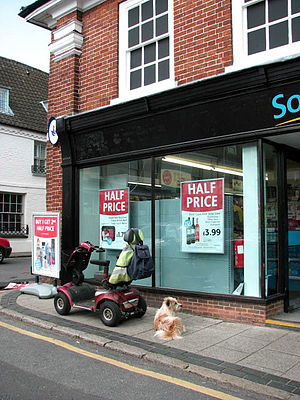
A scooter outside a shop (Photo credit: Wikipedia)
I have also had some horrible experiences using one. Before Christmas I rented one to do my Christmas shopping. It was the first time I had been alone using one and I hadn’t realised how much I had been relying on the other person. I found doors that opened outwards, so I had to sit and wait in the freezing snow for someone kind enough to open it for me. I got stuck in shop displays, and people stepped out in front of me, even on the lowest speed possible and me calling out to them. It was like I was invisible. As my shopping piled up in the basket, I could no longer leave the scooter outside while I went in shops, as I couldn’t carry it all.
I went into WH Smith. First of all I couldn’t get to the part of the shop I wanted to due to the layout of the displays. A customer kindly fetched the item for me. I then attempted to queue, but the layout of the tills was so awful and tight, I banged into the barrier, and all of my shopping fell off – breaking some items. I hobbled off and tried to pick it all up, when it happened again. I was exhausted and tired, but had already entered the queuing system so I couldn’t back out again. Someone stepped over me while I was trying to pick my items up to queue in front of me like I wasn’t even there.
A customer saw my difficulty and pointed it out to three members of staff, who ignored me. In order to manoeuvre round the barriers, I had to crash multiple times into their displays, causing everyone to look at me and probably mumble about scooter drivers being a danger to society. But there was no other choice in order to get out, as it was too tight.
I finally reached the till, and a member of staff walked over and said, “Can I help?” I wanted to throw my broken items at her, but didn’t want to spend Christmas in prison for assault.
I wrote a letter to WH Smith in December detailing the issues, and suggested that due to their till layout, they have a till right at the end for wheelchair and scooter uses, as well as anyone with another disability that would find it difficult to use the queuing system.
They didn’t bother to acknowledge my letter, until the local access group got involved for me. I found them such a help I then joined, and became a committee member. They agreed to make changes, but sadly at this date this haven’t done so.
I now have my own manual wheelchair from the NHS, which is great, but I still long for the day I can get an electric wheelchair and have some independence.
by The Chronic Chronicles | Jul 6, 2011 | Education
This blog post ‘I have sent my child to stay with strangers’ by Scottish Mum gives an excellent account of what it’s like to have a non-neurotypical child.
Some respite allowed her a time out from a very exhausting life. Giving her and others like her a regular time out allows families to rest and recuperate, and the ene
rgy to deal with day-to-day life. It’s invaluable.
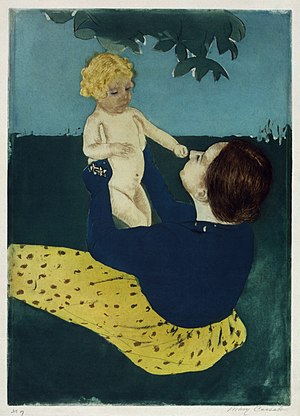
Mother and Child. “Under the horse chestnut tree” (Photo credit: Wikipedia)
It underlines the importance of how you react to a parent dealing with a tantruming child. I remember babysitting my cousin, who had a tantrum in a busy shop as two year olds are wont to do. I particularly remember the embarrassment and the looks people gave me. Imagine the looks a parent of an older child gets, never a thought to why, or how the parent is doing – just judgement.

by The Chronic Chronicles | Jul 4, 2011 | Daily Life, Opinion, Vents
One thing that really frustrates me is that whenever I try and help myself, I find myself banging my head against a brick wall. Just some examples:
If I want a simple referral to a consultant, I seem to have to jump (well, stumble!) though a million hoops first.
I have been waiting over 18 months – not even counting the waiting list for Social Services first – for a disabled bay to be put in, and it’s still not done.
I was given a wheelchair on the NHS that didn’t fold, so I couldn’t really use it properly as it was such a nightmare to get in and out the car.
I have been turned down for Disability Living Allowances twice at Tribunal level, despite lots of medical evidence. (This will be detailed in another post, as I have lots to say about that!)
The council ‘band’ people in categories in order to be eligible for housing. I have been put in a crap band that means I’ll never be able to move , even after an appeal twice now, and have called my medical conditions minor.
I try my best to work, even though it almost kills me to do so, and it’s the reason why some people don’t think I’m as bad as I am.
Okay, just feeling a bit frustrated at the moment!
Credit to ralaenin

by The Chronic Chronicles | Jun 8, 2011 | Daily Life, Employment/Work
For me, work is one of the most important areas to be running smoothly in my life. It costs me an enormous amount to work, but not in money – I pay in pain, energy levels, and stress. It means not being able to have trips out. It means if I have a family wedding I need to take not just the day off – but days surrounding it to recover. It means an extremely limited social life. And this means I want the payoff to be worth it.
I have had numerous issues in the work place over my disability which are often caused by a simple lack of understanding. Sometimes a lack of understanding of my illness, and sometimes quite simply of the law.
My first job was while I was at Sixth Form College, and it was at DFS, a sofa company. The job involved filling out the finance forms for customers after they had purchased a sofa and assisting customers by answering questions about the stock.
My back constantly hurt, and standing was the biggest culprit for causing even more pain. I took the job on the understanding that we were able to sit down when we weren’t serving a customer. Unfortunately, the manager had other ideas, and demanded we continually keep walking in circles around the store – even when there wasn’t a customer in sight. I have to describe the act of walking around with pain shooting across my back and down my legs, while surrounded by comfortable sofas, as something akin to torture. I was desperate for customers to come in, so I could snatch a few blissful moments on a sofa while I took their details.
I had absolutely no idea of my rights, and had never heard of the Disability Discrimination Act (now the Equality Act 2010). Not to mention I would never have dreamed of calling myself disabled at that age. I worried if I complained or was caught sitting down, I’d be fired. One day I was phoned to say they didn’t need any casual staff any more, but when I contacted the other staff – found I was the only one who had got this message. I assume in the end, the manager got fed up with me hobbling around, regularly collapsing into seat when I was unable to bare it any longer. Not that I could prove it.
My second job was at a tourist information office. It was fast paced, and my fellow colleagues were sympathetic, and took on the physical jobs, while I in return did more computer based work. But yet again I ran into trouble with my manager. I had told her about my pain condition, and learning from my previous mistake, had carefully detailed what I could and couldn’t do upfront in the interview and was thrilled to still get the job. Yet she couldn’t grasp why it was difficult for me to do certain jobs, and seemed to take an attitude I was just being lazy. She would purposefully pick me out to do physical jobs, while everyone seemed to look the other way.
After university, I was unemployed for some months. While the JobCentre agreed I could only work up to four days, with no standing, or heavy lifting, they began to get difficult about it. They sent me jobs for things I couldn’t do saying I had to apply for it, even if I physically couldn’t do it. One of the jobs was sorting Christmas mail at Royal Mail, another clearing a shop floor. I was told I had no choice but to apply, or I’d be sanctioned.
Job Centre Plus (Photo credit: Wikipedia)
I’d been sending out application after application with no response. I had even made an appointment with the Disability Adviser, hoping for some tailored advice, but instead just said “just continue with what you’re doing.” Some employers I applied for operated the Two Ticks scheme, which works around the basis that if someone ticks
they are disabled and they meet the essential job criteria – they have to offer them an interview, although having applied for a number of these jobs and not heard anything back at all, I’m not sure how it works in practice.
I do think this is a great idea however. I don’t believe it gives people with a disabilities an advantage, as some feel. Instead it’s the combat the very common attitude of employers dismissing disabled people right away – feeling they’ll be off sick a lot, or will be nothing but trouble. The scheme does not guarantee you a job, but allows one small barrier to be broken down and give the employer the opportunity to meet the applicant, and see their skills and work ethic before deciding whether to dismiss them or not. The Depressed Moose details some more issues with the Two Ticks Scheme here.
It’s also a very difficult decision whether to tick it or not. I applied for a job covering a maternity leave at a university and got an interview. In the interview I was asked whether or not I needed any adjustments, and I explained the restrictions. I was then offered the job, but in the conversation the head of the department asked what my disability was. I can’t remember what I said (I didn’t have the diagnosis then), but fatigue must have been mentioned, as her tone changed as she asked if I had “one of those chronic fatigue type things”. I said no, but fatigue comes into it. She then practically withdrew the job offer, saying she was worried I couldn’t do the job, and they had no time to find anyone else if I took it and then quit. I said I could do it, and she ended the phone call saying she needed to think about it.
What she did was very wrong. First of all she had no right to ask me what my disability was – other than as she had done before in regards to adjustments. She also had no right to withdraw the job offer purely based on my disability.
She rang back the next day and said the job offer was conditional on me seeing their occupational health, which was fair enough. I was cleared. It turned out her husband was severely disabled, and she was very understanding with me and was a good manager. But she could have faced legal action on the basis of her reaction. My line manager then went on to say I picked the job up quicker than anyone she’d ever seen, and was always commenting on how efficient I was, which they wouldn’t have seen if they’d chosen to allow a symptom of fatigue to cloud their decision.
Some parts of the job not mentioned in the job description got more difficult for me. It was advertised as an office job, but it actually involved a lot of physical activity. Most of the people in the office were understanding, and some took on a few minor tasks I couldn’t do. One junior manager took umbrage at this, and made the atmosphere unpleasant to the point of him ending up being disciplined for his behaviour towards me. The same junior manager also extremely offended someone visiting an office by declaring dyslexia didn’t exist, and people were simply lazy. It turned out the visitor had dyslexia and got very upset and explained that it was nothing to do with laziness, but processes in the brain, not that the manager took any notice.
Finally, I found an understanding manager in my third job, who is sadly leaving today and the charity I work for is being taken over by another one. My manager had previously lived with chronic pain herself, she understood sick leave, being able to only work on certain days and made allowances for me to work from home. This has led to some minor grumblings within the team, and the idea I was getting special treatment.
What I try and explain to people is that some people need additional help in order to be equal with everyone else. When someone is at a disadvantage, providing additional support isn’t favourable treatment, it’s helping them to reach the same level as everyone else.
Sadly, not everyone sees it that way.
It’s incredibly difficult to find an employer that will take people on with my multitudes of health problems. One bright side is that the Equality Act 2010 has given additional rights to disabled people that may help in some ways, such as not being able to carry out pre-employment medical questionnaires, or ask about a disability up front. Yet employers continue to do it. It’s also difficult to hide visible disabilities, like going into an interview with a walking stick.
The difficulties I have had make me worry even more for all the people being taken off Incapacity Benefit and assessed for Employment and Support Allowance, but instead being declared fit to work. Some even find themselves turned away at the JobCentre, as they’re declared not fit for work!
All I can suggest is keeping an eye on your rights, and fighting for them when you can.

by The Chronic Chronicles | Jun 4, 2011 | Diagnosis, Hospitals
Most suffers of a chronic illness will tell you how difficult it is to get a diagnosis. The first difficulty is often the doctors, who simply may not know. So many conditions have overlapping symptoms and tests don’t always get to the root cause quickly. Often it takes a doctor that will look at the whole picture, not just run a blood test here and there. I recently heard of a woman whose local doctors wanted to take her thyroid out, believing it to be the cause of her issues. It took a consultant in London who finally ran the correct scans to find out the problem was with her heart, and could be corrected with medication – scans that could have easily been done previously.
Other doctors may be unwilling to commit to a name of condition – perhaps through fear of being incorrect, or other reasons. Some think giving a name of a condition is branding the patient with a ‘label’.
When you’re so unwell it’s impacting your life, the vast majority of people want to know why. They want a to find out what’s wrong with them so they can research their own condition, or join a support group, or simply so when people ask what is wrong with them, they don’t have to shrug and say ‘your guess is as good as mine’.
Woolly symptoms like ‘pain’, ‘fatigue’ (and I’m sure you can name a million of your own) are hard to explain to people, when you’ve cancelling a night out for the fourth time in a row, or taking more sick time from work, or even applying for benefits. Everyone has those symptoms at times, and it’s hard to understand what it’s like when they become an every day occurrence, or never go away. Or when the pain or fatigue become so crushing you can’t function.
Another problem with chronic illnesses is making sure you’ve got the right diagnosis. Due to the aforementioned intersecting symptoms, it can be hard to pin down exactly what’s wrong with you.
For example constant pain, fatigue and cognitive impairment could be down to a virus, or ME, Multiple Sclerosis, Sleep Apnoea, Hypothyroidism, Lyme Disease, Lupus, Fibromyalgia, Depression, the Flu, or something else entirely!
In an ideal world a doctor would come up with a list of everything it could be and then rule each one out with tests. But it isn’t an ideal world, and doctors are often constrained by time, budgets or equipment. Their personal prejudices may come into play. If someone who is slim presented those symptoms, they may take an entirely different approach to someone who is overweight. Many of my grandads’ ailments have been dismissed with ‘it’s your age, it happens to everyone’ and similarly doctors point at my weight as the problem – rather than seeing someone who has put on weight from being unable to exercise and comfort eating due to pain.
If perhaps I’d been listening to when I was ten years old and complained my limbs hurt, and my knees and ankles kept giving way, they would have discovered I was hypermobile, and given me the correct treatment to strengthen my joints. Then it may have been I wouldn’t have developed chronic pain and Fibromyalgia. Or perhaps I was destined for Fibromyalgia no matter how many stretches I had done as a child. I don’t know.
It took me until the age of 23 until I finally saw a Consultant Rheumatologist who spent time thoroughly looking at my history and symptoms to diagnose me with Ehlers-Danlos Syndrome, Fibromyalgia, Myofascial Pain and Postural Orthostatic Tachycardia Syndrome.
I have seen so many other consultants who were dismissive, or shrugged their shoulders. One doctor even said I was Hypermobile, and then a year later forgot he had done so and declared I was fine without reading my history.
Finally, I’d like to point out that many people in England do not realise that they have the right to be seen at any NHS hospital in the country. You do not have to go to the nearest, or the one your GP decides to send you to. If you hear of department in a specific hospital that seems to do a better job than your own – you can choose to go there. You cannot demand you see a specific doctor, however, but you may request to do so. I’ve often found I can see the doctor I’d like by simply waiting longer.
Please keep fighting for your diagnosis if you think something is wrong. Don’t give up.
by The Chronic Chronicles | Jun 3, 2011 | General Posts
Living with chronic conditions isn’t easy. I have started this journal to hopefully connect with fellow sufferers, to education people, to let off some steam, and to post things of interest to those of us living with disability.
Anyone is welcome and I appreciate comments.